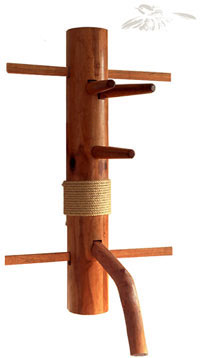

When someone is already within striking distance, the question is no longer just how hard you can hit. It is whether you can feel, redirect, and control the arms between you and the threat. Wing Chun arm control trains that demanding close-range skill: keeping your own line protected while creating a position from which you can strike, off-balance, disengage, or move to safety.
This is not about grabbing an opponent’s wrist and hoping they cooperate. Effective arm control depends on structure, timing, contact sensitivity, body position, and footwork. It is a practical skill, but it must be trained progressively against changing pressure.
What Wing Chun Arm Control Is Designed to Do
At close range, both people may be trying to strike, shove, grab, or tie up the other person’s arms. Wing Chun teaches students to avoid treating each arm as an isolated problem. Instead, the goal is to manage the space and line between two bodies.
A useful control position does several things at once. It protects your center, places your hands in a position to interrupt incoming force, and gives you a direct route to respond. The best position also affects the other person’s posture or base. If their shoulders turn, their weight shifts, or one side becomes crowded, their ability to strike cleanly is reduced.
That is why arm control in Wing Chun is closely connected to striking. A hand that checks, guides, pins, or redirects should not become a dead hand. It should create an immediate opportunity for the other hand, elbow, knee, or step to work. This is the principle of coordinated offense and defense, not a sequence of separate blocks followed by separate attacks.
Structure Comes Before Strength
A common beginner mistake is trying to overpower the other person’s arm with shoulder and bicep strength. That approach can work briefly against a smaller or less committed partner, but it fails when the pressure increases. It also tires the body quickly and can pull your own posture out of position.
Wing Chun uses alignment to make control more efficient. The wrist, elbow, shoulder, spine, and stance must support one another. The elbow generally stays connected to the body rather than flaring away without purpose. The shoulders stay relaxed enough to react, while the stance provides a stable path for force into the ground.
Good structure does not mean becoming stiff. A rigid arm can be pulled, folded, or redirected. A soft arm without structure can collapse. The training goal is connected pressure: firm enough to maintain your line, mobile enough to change when the force changes.
This distinction matters in self-defense. If someone pushes hard, pulling directly backward may give up balance. If someone pulls you forward, resisting with only the arm can make you easy to control. A trained response uses the whole body, adjusts the angle, and keeps the feet involved.
The Elbow and Centerline
The elbow is one of the most important points in Wing Chun arm control. When it remains properly positioned, it helps protect the centerline and supports forward intent without reaching. When it drifts too far outside the body, gaps often open near the ribs and center.
This does not mean the elbow never moves outward. Real movement requires changes in angle, clearing motions, and controls on the outside line. The principle is that every movement should have a reason. An elbow that travels should help you redirect force, create an angle, control the opponent’s base, or open a path for a strike.
Sensitivity Training Makes Contact Useful
Wing Chun is known for Chi Sao, often called sticky hands training. Chi Sao is not a game of trapping hands or a contest to see who can perform the fastest technique. Properly trained, it develops sensitivity under contact.
When your forearms touch another person’s arms, you receive information. You can feel whether they are pushing, pulling, stiffening, withdrawing, or leaving a gap. Instead of relying only on sight, which can be slow at very close range, you learn to respond to pressure changes through touch.
This is where arm control becomes more than a memorized technique. A tan sao, bong sao, pak sao, or lap sao is not valuable because of its name. It is valuable when it matches the pressure you actually feel and places you in a better position than you were in a moment earlier.
Sensitivity does have limits. Contact drills do not replace distance awareness, verbal de-escalation, conditioning, or training against strikes that begin outside touching range. They are a specialized method for the moment contact has already occurred. A complete student learns when to use that method and when creating distance is the safer choice.
Footwork Turns Hand Contact Into Control
Trying to control a person’s arms while standing square in front of them is often a losing exchange. They can bring both hands forward, drive their weight through the center, and force a collision. Wing Chun footwork changes the problem.
A small step, pivot, or shift can move you from directly in front of force to a position beside it. From there, the same amount of hand contact may feel much stronger because you are no longer absorbing pressure head-on. You are guiding it off line while occupying a more favorable angle.
This is why a student should not focus only on hand shapes. If your hands are working but your feet are frozen, arm control will eventually become a strength contest. If the feet move without connected hands, you may create space but lose the ability to protect your line. The two must work together.
For example, when an opponent drives forward with a straight arm, a student may redirect the arm while stepping to an outside angle. The control is not simply the hand on the arm. It is the hand, body turn, and step working as one action. This can disrupt the opponent’s balance and put your own striking line in a stronger position.
Common Misunderstandings About Control
One misunderstanding is that arm control means holding on for a long time. In reality, a control may last less than a second. Its purpose may be to clear a line for a strike, prevent an immediate counter, or create space to leave. Holding too long can expose you to punches from the free hand, head movement, knees, or a change in level.
Another mistake is chasing complicated traps. A trap only works when the opponent’s position, pressure, and timing make it available. Forcing an elaborate hand sequence against resistance often creates openings. The more reliable approach is simple: protect your center, maintain balance, use pressure intelligently, and take the direct opportunity when it appears.
Students also need to understand that controlling an arm does not automatically control the person. The opponent still has feet, body weight, a second hand, and the ability to change direction. Effective training includes awareness of the whole body, especially the opponent’s base. If their feet are planted and their posture is stable, arm pressure alone may not be enough to move them.
How Arm Control Is Trained Safely
At South Florida Wing Chun Kung Fu Academy, close-range training is developed in stages so students can build skill without confusing speed for understanding. Beginners first learn positions, alignment, and basic responses at a manageable pace. They develop the ability to maintain posture while making contact instead of panicking or muscling through every exchange.
As coordination improves, drills become more variable. Partners change pressure, alter angles, and add realistic movement. Students learn to recognize when a position is stable, when it is collapsing, and when they should strike, reposition, or disengage.
Controlled sparring and resistance work matter because they reveal whether an idea holds up when timing is imperfect. Still, intensity should match experience. Training partners must communicate, respect limits, and avoid turning every drill into a contest. Skill grows faster when students can practice often, stay relaxed, and learn from mistakes without unnecessary injury.
Building a Useful Close-Range Skill
Wing Chun arm control is not a shortcut and it is not magic. It is a disciplined method for dealing with contact at a range where fast punches, grabs, and pressure can make untrained reactions unreliable. The value comes from learning to connect your hands, body, and feet so that control creates a practical next action.
For adults and older teens in Doral, Miami, and South Florida who want more than a workout, this type of training offers a clear technical challenge. You do not need prior martial arts experience to begin. You need patience, consistent practice, and a willingness to learn how position beats force when the distance gets close.
The best way to understand the difference is to feel it with a qualified partner. Ask questions, train with purpose, and try out a free class to experience how structure, sensitivity, and footwork change the way close-range defense works.