
A fast reaction is rarely just a fast hand. It is the ability to see a threat, organize your body, maintain balance, choose an angle, and respond without creating a bigger opening. That is why martial arts for coordination and reflexes should involve more than hitting pads as quickly as possible. The best training teaches your eyes, hands, feet, posture, and judgment to work together under pressure.
For adults and older teens, this type of skill development has value far beyond a workout. Better coordination can make movement feel more controlled and confident. Better reflexes can help you respond sooner when contact becomes unpredictable. In Wing Chun Kung Fu, these qualities are developed through structured drills built around close range, direct lines, footwork, and sensitivity to force.
Coordination Is the Foundation of Useful Speed
Many people think coordination means being able to perform complicated movements. In fighting, the more useful definition is simpler: can you move the right parts of your body at the right time without losing structure?
A punch, for example, is not only an arm movement. Your feet need to establish a stable base. Your hips and torso must support the line of force. Your shoulder must remain relaxed enough to transmit power rather than push against itself. Your non-striking hand must protect or control the opponent at the same moment. If these pieces are disconnected, speed often becomes sloppy motion.
Wing Chun develops this connection through repeated, precise actions. Students learn to coordinate stepping with striking, guarding with attacking, and turning with force application. A beginner may first practice these movements slowly to understand position and alignment. As the body learns the pattern, the movement becomes faster without becoming rushed.
This is a key distinction. Speed without control can leave you off balance. Coordination gives speed a purpose.
Simultaneous Hand-and-Foot Movement
Close-range self-defense does not always allow time for a large windup or a perfect fighting stance. You may need to shift your body off line while controlling an arm, striking through an opening, or protecting your center.
Wing Chun training places strong attention on simultaneous action. Instead of treating defense and offense as separate events, students practice using one motion to create both protection and opportunity. A hand may redirect incoming pressure while the other hand strikes. A step may change the angle while improving your ability to control the opponent’s base.
This type of coordination takes practice because the body naturally wants to do one thing at a time. Drills gradually teach the student to combine actions without tangling the shoulders, crossing the feet, or abandoning balance. The result is not choreography. It is a more organized response when distance closes quickly.
What Reflex Training Actually Means
Reflexes are often described as raw reaction time. In martial arts, that is only part of the picture. A useful reaction depends on recognizing what is happening and selecting a response that fits the situation.
If someone throws a straight punch, seeing it early is helpful. But seeing it early does not solve the problem if your hands move away from your center, your feet freeze, or your body leans into the attack. Training improves the connection between perception and action.
Wing Chun approaches this through drills that begin with clear, repeatable inputs. Students may work on responding to a direct line, recovering their center after contact, or feeling whether pressure is pushing, pulling, or changing direction. Over time, the inputs become less predictable. The goal is to remain composed enough to respond efficiently rather than flinch or guess.
Tactile Sensitivity Builds Contact Reflexes
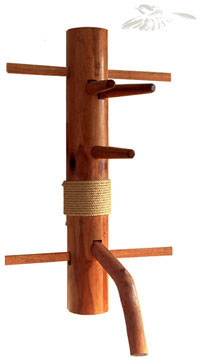
Visual reaction is not always enough at close range. When arms are touching, the body can receive information through contact before the eyes fully process the movement. Wing Chun uses tactile sensitivity training, often called Chi Sao or sticking-hands practice, to develop this skill.
During this work, partners maintain controlled arm contact while changing pressure, lines, and position. One person may press forward, redirect, pull, or create an opening. The other learns to recognize the change and adapt without becoming rigid. This develops a different kind of reflex: not simply seeing an attack, but feeling force and responding to it.
The lesson is practical. If an opponent’s arm is already in contact with yours, trying to visually track every small movement can be too slow. Sensitivity training teaches you to keep your structure, read pressure, and use the available line.
This does not mean contact drills are magic or that they replace sparring and realistic distance management. They are specialized tools. Their value is strongest when students understand the range they are designed for and combine them with footwork, striking mechanics, and controlled resistance.
Why Footwork Makes Reactions More Effective
A quick hand cannot fix poor positioning. If you are standing directly in front of force, with your weight trapped or your balance broken, even a correct technique can fail to create control.
Footwork changes the problem. A small step, turn, or angle can move you away from an opponent’s strongest line while keeping you close enough to respond. It can also help you disrupt their base, reduce their ability to generate power, and create a better path for your own strike or control.
For beginners, footwork is often the fastest way to make martial arts feel more accessible. You do not need extraordinary flexibility or athleticism to begin learning how to stand with balance, shift weight cleanly, and move without crossing your feet. Those skills provide a platform for everything else.
As training advances, footwork becomes more demanding. You must coordinate movement with hands that may already be controlling contact. You must maintain awareness of range. You must avoid stepping into a kick, a takedown, or a line where the opponent can recover easily. The more realistic the drill becomes, the more your coordination is tested.
Martial Arts for Coordination and Reflexes Require Pressure
Solo forms and repetition are useful because they establish mechanics. They teach where your hands should travel, how your body should align, and how to generate force with less wasted motion. But reflexes do not fully develop in a fixed routine.
To build usable responses, training needs progressive pressure. This may include partner drills with changing speed, controlled attacks from different angles, light sparring, pad work that requires movement and decision-making, and contact exercises where the partner does not cooperate perfectly.
Pressure must be scaled correctly. Too little pressure creates false confidence because every technique works on a compliant partner. Too much pressure too early causes students to tense up, abandon mechanics, and rely on panic movements. Good instruction builds difficulty in stages so students can retain structure while learning to adapt.
That balance is especially valuable for adults beginning martial arts. You do not need to arrive with elite reactions. You need a training environment that gives you enough repetition to understand the skill and enough resistance to make the skill honest.
What Changes With Consistent Training
Most students first notice that their body feels less disconnected. Their hands stop moving independently of their feet. They become more aware of posture, distance, and where their weight is positioned. This is coordination developing through repetition.
Later, reactions begin to look calmer. Instead of reaching wildly when a partner moves, the student may take a small angle, keep the center covered, or make contact with better structure. This is not about becoming aggressive. It is about reducing hesitation and wasted movement.
Progress varies. Someone with prior sports experience may pick up timing quickly but need to refine close-range mechanics. Someone with little athletic background may need more time to build footwork and conditioning, yet can still make meaningful gains through regular practice. Consistency matters more than trying to force speed before the body understands the movement.
Train the Skill, Not the Illusion
There are plenty of ways to feel fast in a martial arts class. Rapid combinations, flashy drills, and hard pad strikes can be rewarding. They can also hide gaps if the student never has to manage range, contact, balance, or an opponent who changes the situation.
A more disciplined approach asks harder questions. Can you keep your structure when force comes toward you? Can you strike while moving? Can you control an arm without losing your own center? Can you feel a change in pressure and adjust before the opening disappears?
These questions are central to Wing Chun training. They turn coordination and reflexes from vague fitness goals into measurable fighting attributes.
At South Florida Wing Chun Kung Fu Academy, students train these mechanics through focused instruction in striking, footwork, arm control, and tactile sensitivity. Whether you are new to martial arts or looking for a technical close-range system, a free class is a practical way to feel how structured training develops the body. Come join us today and put your coordination to work.