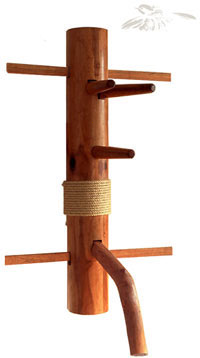

A sudden grab, a crowded hallway, and no room to swing a wide punch changes what martial art training needs to accomplish. When people ask whether to choose wing chun or krav maga, they are usually asking a more personal question: Which training method will help me become more capable under pressure?
Both systems can improve awareness, confidence, striking, and self-protection. They do not, however, build those abilities in the same way. Krav Maga is commonly organized around rapid responses to common threats. Wing Chun is a specialized close-range fighting system built around structure, positioning, contact control, and coordinated force. The better choice depends on what you want to study, how deeply you want to train, and what type of skill development will keep you practicing consistently.
Wing Chun or Krav Maga: The Core Difference
Krav Maga is generally taught as a modern self-defense method. Classes often focus on accessible gross-motor responses to punches, grabs, chokes, weapon threats, and other high-stress situations. Its training goal is direct: recognize danger, make space, disrupt the attacker, and get away. Many students are drawn to Krav Maga because its purpose is clear from the first class.
Wing Chun Kung Fu takes a different route. It is a complete fighting system with a strong focus on the close range where arms collide, grips form, posture breaks down, and distance can disappear in a second. Rather than treating contact as a problem to escape immediately, Wing Chun teaches the student to read and use contact. Through sensitivity drills, arm control, footwork, and striking, the practitioner learns to find openings while controlling the opponent’s line and base.
That does not mean Wing Chun is only for close quarters or that Krav Maga never uses close-range work. It means their training priorities are different. Krav Maga often begins with scenario-based answers. Wing Chun spends more time developing the mechanics that make close-range answers work against changing pressure.
What You Build in Krav Maga Training
A quality Krav Maga program can be an effective choice for someone who wants immediate exposure to self-defense situations. Training frequently includes verbal awareness, escape tactics, defensive striking, pad work, and drills based on surprise attacks. The emphasis is often on making a simple decision fast and acting with commitment.
For a beginner, that can feel practical right away. You may work on how to break a grab, defend against a straight punch, strike vulnerable targets, or create an exit. Classes can also be physically demanding, which appeals to people who want conditioning alongside self-defense instruction.
The trade-off is that the quality of Krav Maga varies greatly from school to school. Some programs provide serious pressure testing, controlled resistance, and clear safety standards. Others may rely too heavily on compliant drills, where an attacker holds still or reacts exactly as expected. A technique that looks decisive when rehearsed can be harder to apply when timing, balance, and resistance change.
Krav Maga students benefit most when their school regularly tests techniques against realistic movement without turning every class into an unsafe brawl. Training should develop judgment, not just aggression.
What You Build in Wing Chun Training
Wing Chun develops the body as a connected fighting structure. A student learns to strike without overcommitting, keep the elbows positioned to protect the centerline, and move the feet so the hands can work from a stronger angle. The goal is not to trade force with force. It is to redirect pressure, occupy space efficiently, and apply force when the opponent is structurally compromised.
This is especially valuable at close range. When a person is pushing, grabbing, leaning, clinching, or throwing wide punches, visual reactions alone can be too slow. Wing Chun sensitivity training develops awareness through contact. Students learn to feel changes in pressure, recognize when a line opens, and respond without needing to pause and identify every movement.
A core part of this work is coordinated action. Instead of blocking first and striking second, Wing Chun trains simultaneous hand-and-foot coordination whenever the opening allows it. A controlling arm can clear a line while the other hand strikes. A step can change the angle and weaken the opponent’s balance while creating a better position for follow-up force.
This technical depth is one reason Wing Chun rewards patience. A new student can learn useful fundamentals quickly, but refined structure, timing, and tactile reactions take consistent practice. For people who enjoy studying mechanics and seeing small improvements compound over time, that process is part of the value.
Range Matters More Than Labels
Neither art should be judged by a single dramatic technique. The more useful question is where and how you expect to operate.
Krav Maga may appeal if your primary goal is broad exposure to personal safety scenarios, including threat recognition and immediate escape. Wing Chun may appeal if you want focused development in close-range striking, arm control, angle creation, and contact-based reactions.
Consider an aggressive person who steps in quickly and begins grabbing or throwing compact punches. At that distance, big movements become difficult. The ability to maintain your base, control the opponent’s arms, and strike along an efficient line matters. Wing Chun is designed to train that range in detail.
Consider instead a person who wants a short-term course centered on awareness, escape, and a basic response to several common attacks. A well-run Krav Maga program may fit that immediate objective well. There is no benefit in pretending every student needs the same type of training.
Does One Work Better for Real Self-Defense?
Real self-defense is not a style name. It includes awareness, de-escalation, legal judgment, physical preparation, and the ability to act under stress. No martial art makes a person invulnerable, and no single drill can reproduce every dangerous encounter.
The practical value of either system comes down to training quality. Are students learning against resistance? Do instructors explain distance, timing, balance, and risk? Is the school honest about what a technique can and cannot do? Are students improving their fitness, composure, and decision-making as well as their technique?
Wing Chun becomes practical when it is taught as an active fighting system, not as a collection of fixed forms. Forms provide a blueprint for position and force, but partner drills reveal whether a student can maintain that structure against incoming pressure. Chi Sao, or sticky-hands training, is useful because it develops reactions during contact, but it must connect to footwork, striking, grappling-based arm control, and live movement.
Krav Maga becomes practical when it goes beyond rehearsed attack patterns. Students need to experience imperfect angles, fatigue, unexpected resistance, and the need to disengage safely. The best programs keep the purpose of self-protection clear while giving students enough pressure to test their habits.
Choosing the Right School for Your Goals
Before deciding between wing chun or krav maga, visit the school and watch how people train. You are not only choosing a style. You are choosing instructors, training partners, safety culture, and a method you will need to practice for months and years.
Look for clear instruction rather than vague promises. In a strong Wing Chun class, you should see students working on stance, footwork, line control, striking mechanics, and partner drills with a purpose. Beginners should receive enough structure to train safely, while advanced students should be challenged to apply their skills against changing pressure.
Ask whether the program has a progression. Good training does not throw a new student into advanced sparring on day one, but it also does not keep students in overly cooperative drills forever. Skill grows when the challenge increases at the right pace.
For adults and older teens in Doral, Miami, and South Florida, an in-person class also provides something online videos cannot: feedback. An instructor can correct a collapsed elbow, an unstable stance, a step that exposes your balance, or a strike that loses its connection to the floor. Those details are where practical power and control are built.
The Better Choice Is the One You Will Train Seriously
Choose Krav Maga if you are looking for broad, scenario-driven self-defense training and your local school pressure-tests its material responsibly. Choose Wing Chun if you want a disciplined system that studies close-range combat in depth and builds your ability to control pressure, create angles, and deliver efficient force.
For many people, the deciding factor is not which art has the better reputation online. It is whether the training makes sense in your body. If you are curious about the mechanics of close-range fighting, come try a free class at South Florida Wing Chun Kung Fu Academy. Feel how structure, footwork, and contact sensitivity work together, ask direct questions, and give yourself the chance to build a skill that becomes clearer with every session.