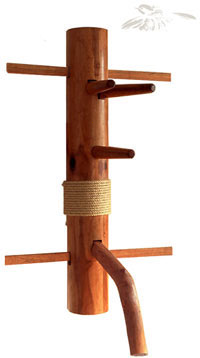

A fast straight punch is easy to understand when no one is touching you. The real test begins when an opponent crowds your space, controls an arm, changes pressure, or disrupts your balance. The best wing chun drills develop the structure, sensitivity, timing, and footwork needed to operate in that range without relying on strength alone.
Good drills are not choreography for their own sake. Each one should teach a usable answer to a specific problem: how to protect the centerline, recover when contact changes, create an angle, disturb an opponent’s base, or strike while controlling their arms. Train slowly enough to recognize the mechanics, then increase speed and resistance only when your position remains sound.
What Makes a Wing Chun Drill Worth Training?
A productive Wing Chun drill has a clear purpose and a measurable standard. You should know what position you are trying to maintain, what pressure your partner is giving, and what makes a repetition successful. If the drill only works because your partner feeds the same attack at the same speed, it has limited value.
The strongest training methods combine contact with movement. Wing Chun is not just hand trapping at a fixed distance. Close-range fighting requires the legs to carry the body into position, the hips to support force, and the hands to remain connected without becoming stiff. Your arms may make contact first, but your base determines whether you can actually control the exchange.
Safety matters as well. Use controlled contact, communicate with your partner, and wear appropriate protective equipment when adding strikes. The goal is to sharpen reactions and force adaptation, not to turn every technical round into a hard sparring match.
8 Best Wing Chun Drills for Practical Training
1. Stance and Centerline Step Drill
Begin in a balanced Wing Chun stance with your hands protecting the centerline. Take short steps forward, backward, and diagonally while keeping your head level, knees aligned, and weight ready to transfer. Your hands should not drift away from the center just because your feet move.
A partner can add a light forward push or touch to either shoulder as you step. This reveals whether your stance is connected or whether you are reaching with the upper body. The objective is not to stay rooted in one place. It is to remain organized while changing distance.
This drill is especially valuable for beginners because footwork lowers the barrier to entry. Before someone can apply complex arm control, they need to understand how to arrive at the right range without leaning, crossing their feet, or losing their base.
2. Pak Sau and Straight Punch Entry
One partner feeds a straight punch. The defender uses pak sau, a directing slap or deflection, while stepping slightly off line and delivering a straight punch with the opposite hand. The drill trains a core Wing Chun idea: defense and offense should work together rather than occur as two separate events.
Do not swing the pak sau across the body. A large motion creates an opening and often pulls your shoulder out of position. Keep the action direct, use a small angle, and make sure the step supports the punch. Once the basic movement is clean, vary the feeding hand, rhythm, and distance.
The trade-off is important. Pak sau is not a magic answer to every punch. Against a committed strike it can create a line; against a fast combination, you may need to cover, move, or make more substantial contact first. The drill teaches entry mechanics, not a guaranteed script.
3. Tan Sau Pressure and Recovery Drill
Tan sau is often misunderstood as a static hand shape. In training, it should be a responsive structure that redirects pressure while maintaining forward intent. Have a partner apply controlled pressure to your forearm or throw a straight line toward your center. Use tan sau to guide the force without allowing your elbow to flare too far from your body.
The key is recovery. After redirecting the pressure, return immediately to a usable striking or controlling position. If your tan sau stays extended after the moment has passed, you have given away your centerline. Practice on both sides, then add a follow-up punch or step.
This drill builds awareness of elbow position and shoulder tension. If your shoulder rises and hardens, you will feel strong for a moment but become slow to adapt. Stay connected through the stance and allow the structure, not muscular bracing, to do the work.
4. Rolling Hands for Tactile Sensitivity
Chi sao, often called rolling hands, is one of the most recognized Wing Chun training methods. Done correctly, it develops the ability to read pressure through contact. Partners maintain light forearm connection while rolling through familiar positions, looking for changes in direction, gaps, excessive force, and loss of structure.
The mistake is treating chi sao as a game of fast hands. Speed without control encourages chasing, slapping, and overcommitting. Start with enough pressure to feel your partner, but not so much that both people lock up. When a line opens, use a simple strike, cover, or angle rather than a complicated sequence.
For practical development, include a clear reset. After a clean entry or controlled strike, return to the starting position and identify why it worked. Was your partner’s elbow displaced? Did they overextend? Did you use footwork to improve the line? This turns rolling hands into a study of cause and effect.
5. Lap Sau and Arm-Control Exchange
Lap sau trains pulling control, striking coordination, and recovery after an arm is briefly cleared. One partner pulls or checks an arm while striking; the other maintains position, responds with their own control, and returns a direct strike through the available line.
The pull should not be a wide tug. Effective lap sau uses a short motion connected to body position. Pulling too hard can draw you into your partner, compromise your balance, and leave your own center exposed. A small pull combined with a step or turn can be much more effective.
Train this drill with progressive resistance. First, learn the exchange cooperatively. Then let each partner vary the timing, retract the arm, or counter the pull. The purpose is not to memorize a chain. It is to recognize when arm control creates a brief striking opportunity and when it does not.
6. Wall Bag Straight-Punch Drill
A wall bag gives immediate feedback on alignment and force delivery. Stand close enough that your punches remain compact. Strike with a vertical or natural fist orientation according to your school’s method, keeping the wrist aligned, elbow behind the punch, and shoulder relaxed.
Use short rounds focused on quality. Ten precise punches with stable structure are more useful than one hundred punches performed while the elbow flares and the wrist collapses. Add a small step only after you can hit without reaching.
The wall bag builds impact tolerance and helps students understand explosive force. It does not replace partner training. A bag does not change angles, hit back, or disrupt your balance. Use it to improve mechanics, then bring those mechanics back into moving drills.
7. Angle Step and Base-Control Drill
At close range, a small angle can change the entire exchange. Start with light forearm contact. Your partner applies forward pressure or feeds a basic straight attack. Instead of retreating straight back, step to a safe angle while using a controlled arm position to redirect their line.
The focus is on moving your body where the opponent is weaker, not merely moving your hands around their hands. As you angle, pay attention to their feet and hips. If they must turn, cross-step, or recover their posture, their base is temporarily less stable and your options improve.
Keep this drill realistic by avoiding oversized steps. In a crowded environment, you may only have enough room for a short adjustment. Train the smallest useful movement first, then explore larger angles when space permits.
8. Controlled Entry-to-Exit Sparring
The final drill connects technical training to a more alive exchange. Begin at close range or at a range where one partner can enter with a straight attack. Work for a short round with limited goals: establish contact, create an angle, land controlled body-level strikes, and exit safely when the position is lost.
Set rules that match the students’ level. Beginners may use light contact and a narrow set of attacks. More experienced practitioners can add clinch pressure, low-line kicks, and freer entries. The standard is not whether someone wins the round. It is whether they can maintain awareness, structure, and composure when the partner stops cooperating.
How to Build the Drills Into a Weekly Practice
A balanced session does not need every drill at maximum intensity. Start with stance, stepping, and a few minutes of clean punching. Move into one contact drill such as tan sau pressure, rolling hands, or lap sau. Finish with angle work or controlled sparring so the technical material has a chance to function under uncertainty.
Choose one primary objective for each session. If you are working on footwork, do not judge the entire class by hand speed. If you are working on sensitivity, keep the contact relaxed enough to feel changes. Focused repetition creates better results than trying to train every Wing Chun skill at once.
Students in Doral, Miami, and across South Florida often come to Wing Chun looking for practical self-defense, but practical skill is built through consistent technical work. Come train with attentive partners, ask questions about the mechanics, and try out a free class when you are ready to feel how close-range control is developed firsthand.