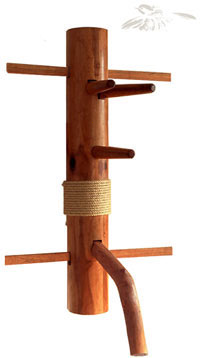

A busy work schedule, an old sports injury, or years away from exercise can make stepping into a martial arts school feel intimidating. But traditional martial arts for adults are not reserved for people who started as children or want to collect belts. The right school gives adults a structured way to develop balance, timing, fitness, composure, and practical self-defense skills at a pace that rewards consistent effort.
Wing Chun Kung Fu is especially suited to adults who want more than a general workout. It is a close-range fighting system built around body structure, efficient movement, direct angles, and control during contact. Rather than depending on athleticism alone, students learn how position, timing, and coordinated force can create an advantage.
Why Adults Choose Traditional Martial Arts
Many adults begin training because they want to feel safer. Others want a challenging discipline that does not feel like another repetitive gym routine. Some have tried broad martial arts programs and are now looking for a system with deeper technical study.
Traditional training provides a framework for all of those goals. Classes are not simply about throwing punches until everyone is tired. Students repeat specific movements, learn the purpose behind them, test them with a partner, and gradually apply them under greater pressure. That process builds skill that can be measured in clearer footwork, better posture, faster reactions, and calmer decision-making.
There is also a difference between being active and being physically capable. A person can be strong, flexible, or cardiovascularly fit yet still freeze when someone enters close range. Martial arts training addresses distance, contact, angles, and the ability to respond when an opponent disrupts your position. Those are skills that ordinary fitness programs rarely teach.
Traditional does not mean outdated. It means that training is organized around a proven body of principles rather than whatever exercise happens to be popular that month. The value is in the method: focused repetition, partner drills, correction, and progressive application.
What Makes Wing Chun Different for Adult Students
Wing Chun is a traditional Chinese martial art with a highly specialized approach to close-range combat. Its movements are compact, but the system is not simplistic. Students learn to protect the centerline, occupy useful space, control an opponent’s arms, disrupt their base, and strike through efficient pathways.
For adult beginners, this can be a practical starting point. You do not need to be the fastest person in the room to understand a direct line, improve your stance, or learn how to keep your balance when contact is made. You do need patience and a willingness to pay attention to details.
A Wing Chun class commonly develops several connected abilities:
- Striking mechanics that use alignment, timing, and explosive force rather than wide, telegraphed swings.
- Footwork that creates angles, protects balance, and helps a student enter or exit close range with purpose.
- Arm control and grappling-based contact that limits an opponent’s ability to strike freely.
- Kicking that supports position and balance rather than replacing hand control at close range.
- Tactile sensitivity training, often developed through partner drills, that teaches students to feel pressure and adapt when visual information is limited.
These elements matter because a confrontation does not always begin at the distance people imagine. Personal space can disappear quickly. A person may grab, shove, crowd, or swing from close range. Wing Chun training prepares students to recognize and manage that type of contact instead of relying only on techniques practiced from far away.
Traditional Martial Arts for Adults Require Smart Training
Adults should expect to be challenged, but challenge is not the same as punishment. A good martial arts program builds intensity in stages. First, students need enough control to stand correctly, move without crossing their feet, coordinate their hands and legs, and understand basic lines of attack and defense. Trying to spar hard before those habits exist usually creates sloppy movement and unnecessary injuries.
As skills improve, training becomes more alive. Partner drills introduce timing, resistance, pressure, and unpredictability. Students learn that a technique may work cleanly in one position but fail when their posture is broken, their angle is wrong, or their opponent applies force in a different direction. That feedback is valuable. It turns martial arts from memorized choreography into problem-solving under contact.
Adults also need to train honestly around their own bodies. Someone returning to exercise after ten years may need to build mobility and conditioning gradually. A more experienced athlete may adapt quickly to the physical workload but need to slow down and refine habits developed in another style. Neither situation is a disadvantage if the student trains consistently and listens to instruction.
The goal is not to imitate a younger athlete. The goal is to become more capable than you were last month.
Skill Development Beyond the First Class
The first few weeks of training often reveal how much coordination is involved in a simple stance, step, or punch. That is normal. Wing Chun asks the body to work as a connected structure. The feet create the base, the hips and torso organize the movement, the arms maintain position, and the eyes read the opponent’s line.
Over time, students begin to feel the connection. Their movements become less forced. They stop reaching with their hands and start using their footwork to arrive at a better angle. They understand why controlling an arm is not merely grabbing it, but managing the space where it can strike. They learn that power is not only muscular effort. It is also alignment, timing, body rotation, and the ability to apply force without losing their own balance.
This is where traditional practice becomes rewarding for adults. Progress is not limited to a single measurement like weight loss or how many push-ups you can do. You notice it when you recover your posture faster, recognize pressure sooner, stay composed during a difficult drill, or solve a problem that once made you tense.
What to Look for in an Adult Martial Arts School
Not every school serves adult students in the same way. Before committing, pay attention to how instruction is delivered. Are beginners taught the purpose behind movements, or are they expected to copy the class without guidance? Is partner training controlled and progressive? Does the school explain how technique changes with range and resistance?
A serious program should make room for questions. Martial arts is hands-on, but it should not be mysterious. Students should understand why a stance matters, why an angle is safer, and why a particular response works better against a push, grab, or incoming strike.
It also helps to decide what you want from training. If your only goal is high-intensity exercise, a fitness-focused program may be enough. If you want practical self-defense skills, technical depth, and a discipline you can study for years, a traditional system such as Wing Chun offers a different kind of value.
The culture matters as well. Adults learn best in an environment that is focused without being hostile. Training partners should push one another to improve while maintaining control. A welcoming school does not lower its standards. It gives beginners a clear path to meet them.
Start Where You Are
You do not need prior experience, exceptional flexibility, or a martial arts background to begin. You need the willingness to show up, practice fundamentals, and accept that good skill takes time. A free introductory class can answer practical questions quickly: how the school teaches, what the training feels like, and whether the system matches your goals.
At South Florida Wing Chun Kung Fu Academy, adults can train the mechanics of close-range self-defense through structured instruction, partner work, footwork, striking, and tactile sensitivity drills. The first step is simply getting on the floor and experiencing the system for yourself. Come join us today and try out a free class.