
A Wing Chun vs Muay Thai comparison is not about declaring one art universally better. It is about understanding what each system trains you to do under pressure. Both can build conditioning, confidence, timing, and real fighting ability. Their strategies, preferred ranges, and training methods are very different.
For an adult choosing a martial art for practical self-defense, that difference matters. A person who wants to develop sharp close-range control may be drawn to Wing Chun. Someone who wants a striking sport built around hard kicks, knees, elbows, and a competitive clinch may prefer Muay Thai. The best choice depends on your goals, your willingness to train consistently, and the quality of instruction available to you.
Wing Chun vs Muay Thai: The Core Difference
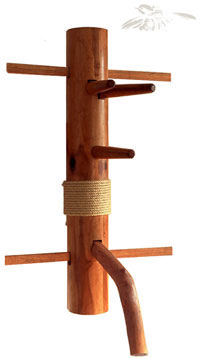
Wing Chun is a close-range fighting system built around direct lines, economy of movement, structure, and control during contact. Rather than trading wide strikes from outside, Wing Chun teaches practitioners to occupy the center, create angles, disrupt an opponent’s balance, and strike while controlling the opponent’s arms or position.
Muay Thai is a striking art known for its punches, round kicks, knees, elbows, and clinch fighting. It is often called the art of eight limbs because it uses fists, shins, knees, and elbows as primary weapons. Modern Muay Thai is strongly connected to ring competition, so many schools place heavy emphasis on pad work, conditioning, sparring, and the ability to deliver and absorb force over multiple rounds.
Neither approach is simple. Wing Chun asks students to develop sensitivity, body alignment, coordinated forward pressure, and quick adaptation when arms make contact. Muay Thai asks students to develop striking power, defensive awareness against kicks, durable conditioning, and control in a demanding clinch.
Range Changes Everything
The clearest difference between the two arts is where they prefer to work.
Muay Thai is highly effective from kicking range through punching range. Its round kick can attack the leg, body, or head from outside hand range. A teep, or push kick, can interrupt forward movement and create distance. As the fighters close, Muay Thai adds punches, elbows, knees, and clinch control.
Wing Chun focuses heavily on the moment where distance collapses. This is the range where a person may be trying to grab, shove, punch repeatedly, or tie up your arms. Wing Chun training develops the ability to maintain a useful position when contact occurs, rather than treating contact as a failure. Students learn to feel pressure through the arms, redirect force, clear obstacles, and strike along a direct path.
That does not mean Wing Chun ignores distance. Footwork is essential. A student must learn how to enter safely, change angles, avoid standing in front of an opponent’s power, and control the opponent’s base. But the system is especially valuable once the exchange becomes crowded and fast.
For self-defense, this close-range emphasis can be practical. Real confrontations often begin closer than a sporting match. There may be limited space, uneven footing, emotional aggression, or an opponent reaching for clothing or arms. Wing Chun gives students a technical framework for dealing with that kind of contact.
Striking Power and Weapon Selection
Muay Thai has a wider set of commonly trained long-range and mid-range striking tools. Its round kick is a major weapon because it can create immediate damage and change how an opponent moves. Knees and elbows are also powerful at close range, particularly when a fighter has strong head and arm control in the clinch.
Wing Chun generally favors compact strikes that travel efficiently. Straight punches, palms, elbows, low kicks, and short explosive force are delivered while the practitioner attempts to maintain structure and position. The goal is not to throw a large number of isolated techniques. It is to connect striking with control, so a hand that clears or traps can become a hand that hits.
This is where people often misunderstand Wing Chun. Its short-range power is not meant to be weak power. When body alignment, timing, and forward force are trained correctly, compact strikes can be fast and disruptive. However, developing that power requires technical repetition and live training. A student cannot rely on choreography or assume that a straight-line approach works without pressure testing.
Muay Thai’s weapons can be more immediately recognizable, especially for beginners. You can see and feel the impact of a kick on pads quickly. Wing Chun’s advantages often become clearer over time as students learn to coordinate their hands, feet, structure, and reactions during contact.
Clinching, Grabbing, and Arm Control
Both systems work at close range, but they approach control differently.
The Muay Thai clinch is built around positional dominance, especially control of the head, neck, and arms. Fighters use grips, frames, pummeling, off-balancing, knees, and sweeps. A skilled Muay Thai practitioner can make close range exhausting and painful, especially if they establish posture control.
Wing Chun uses contact to read and manipulate pressure through the arms. Training methods such as Chi Sao, often called sticky hands, develop tactile sensitivity. Students learn to recognize openings, maintain forward intent, change lines when force meets force, and avoid getting stuck in a contest of pure strength.
This does not mean Chi Sao is a substitute for sparring or grappling. It is a training method, not a magic answer. Its value is in teaching fast reactions, arm control, structural awareness, and force adaptation. Those attributes must then be integrated with footwork, striking, resistance, and realistic movement.
A strong practical program should also acknowledge the limits of standing control. If a situation turns into a prolonged wrestling exchange or goes to the ground, additional grappling training may be useful. Good self-defense training is honest about range and does not pretend one set of drills covers every possibility.
Conditioning and Training Culture
Muay Thai is usually more physically punishing from the first class. Training often includes running, jump rope, heavy bag rounds, pads, calisthenics, clinch rounds, and sparring. Shin conditioning and impact tolerance are part of the culture at many schools. For people seeking an intense combat-sports workout, that can be a major advantage.
Wing Chun can also be demanding, but the challenge is often more technical at the beginning. Students work on stance, alignment, stepping, hand positioning, timing, relaxation under pressure, and coordinated striking. As training advances, drills become more dynamic. The body has to move as one unit while responding to changing contact.
The better training environment is not necessarily the one that leaves you most exhausted. It is the one that develops usable skill safely and consistently. You should expect physical effort, but you should also receive clear coaching on distance, structure, defense, partner control, and why a drill matters.
For older teens and adults, the right school also makes a difference in long-term consistency. A beginner should be challenged without being thrown into uncontrolled sparring. An experienced athlete should be given enough resistance and detail to keep progressing. Technical depth and responsible training are not opposites.
Which Art Is Better for Self-Defense?
It depends on the situation and the student. Muay Thai offers proven striking tools, exceptional conditioning, and strong training for clinch pressure. It can be an excellent choice for someone comfortable with a more athletic, impact-heavy, competition-oriented environment.
Wing Chun is a strong fit for someone who wants to study close-range mechanics in detail. Its emphasis on direct striking, arm control, angle creation, balance disruption, and tactile response can be especially relevant when a confrontation becomes tight, messy, and difficult to predict.
The most useful question is not, “Would Wing Chun beat Muay Thai?” A skilled practitioner in either art is shaped by coaching, training time, athletic attributes, sparring experience, and decision-making under pressure. The question is what skills you want to build and whether you will train them seriously.
If you are choosing between the two, watch a class before deciding. Look for controlled partner work, purposeful footwork, realistic resistance, and instructors who can explain both the strengths and limits of what they teach. Avoid schools that promise guaranteed outcomes or dismiss every other martial art.
At South Florida Wing Chun Kung Fu Academy, students train the structure and close-range coordination that make Wing Chun a specialized self-defense system. If you are in Doral or the Miami area and want to feel how this training works firsthand, try out a free class. The right art is the one that gives you a reason to return, improve, and build skill that holds up when pressure closes the distance.