
A beginner does not need to arrive knowing how to punch, kick, or wrestle. The right self defense classes for beginners start with a more useful question: can you recognize pressure, keep your balance, and create a way out when someone gets too close? Those skills are built through training, not bravado.
For many adults and older teens, the hardest step is walking through the door for the first class. They may worry about fitness, coordination, age, or having no prior martial arts experience. A serious school should make that first step clear and manageable while still treating self-defense as a real skill that deserves focused practice.
What a Beginner Should Learn First
Good self-defense instruction does not begin with complicated combinations or flashy techniques. It begins with structure. You need to know how to stand in a way that supports movement, how to maintain your base when another person applies pressure, and how to use your hands and feet together rather than as separate tools.
Awareness is part of that foundation. Many dangerous situations are avoided by noticing distance, behavior, exits, and changes in a person’s posture before physical contact occurs. Training should never promise that every confrontation can be solved with a technique. The safest outcome is often to leave early, create space, and get help.
When contact cannot be avoided, beginners need practical answers to close-range problems. Someone may grab an arm, crowd your space, push forward, or throw wide, uncontrolled strikes. A useful class teaches you to protect your centerline, manage the opponent’s arms, control angles, and move without crossing your feet or giving away your balance.
This is why technique matters more than athleticism at the beginning. Speed and strength help, but body position, timing, and direction determine whether your effort is effective. A smaller person who understands leverage and positioning has more options than a stronger person who freezes or overcommits.
Why Wing Chun Fits Self Defense Classes for Beginners
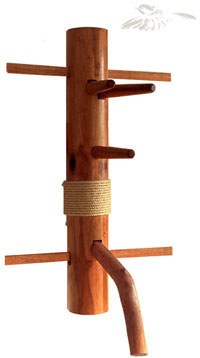
Wing Chun is a close-range fighting system built around direct lines, efficient motion, coordinated striking, and control during contact. It is not based on trying to overpower an opponent with large movements. Instead, it teaches students to use structure, forward intent, and angle creation to deal with pressure at a range where many untrained people become overwhelmed.
For beginners, that focus can be especially valuable. Real confrontations do not always begin at a clean kicking distance. They can start with someone invading your personal space, grabbing clothing, pushing, or throwing punches from close range. Wing Chun training addresses the moment when there is little room to swing your arms freely.
A beginner will work on stance and footwork early. Footwork is not just moving around the room. It teaches you to preserve your base while adjusting your position relative to another person. A small step to the outside can change the line of an attack. A controlled retreat can create space. A stable turn can redirect force without meeting it head-on.
Students also learn simultaneous hand-and-foot coordination. Rather than treating defense and offense as completely separate actions, Wing Chun develops the ability to intercept, control, and respond in one connected movement when the opening is there. That does not mean every situation calls for striking. It means your body is learning to react with purpose instead of panic.
What Training Actually Feels Like
Your first classes should feel technical, not chaotic. You may practice a stance, basic steps, palm strikes, straight punches, and simple defensive shapes before working with a partner. Repetition is normal. It gives your nervous system time to recognize positions and makes good mechanics more reliable under pressure.
Partner training is where self-defense becomes more than solo exercise. At first, the contact should be measured and supervised. You learn how an arm feels when it pushes into yours, how your balance changes when someone presses forward, and how to avoid becoming stiff when resistance appears. These are physical lessons that cannot be learned by watching videos alone.
In Wing Chun, tactile sensitivity training develops awareness through contact. As students advance, they learn to feel changes in force, direction, and openings through the arms. This is useful when vision is limited by close range, movement, or confusion. It is not magic and it does not replace awareness or judgment. It is a trained response to pressure that improves with patient practice.
Expect to be challenged, but not thrown into situations beyond your level. A responsible instructor scales drills according to experience. Beginners need enough resistance to understand the problem, but not so much that they only learn fear or sloppy survival habits. As coordination improves, the training can become faster, more variable, and more demanding.
How to Choose Your First School
A class can call itself self-defense and still spend most of its time on general fitness or choreography. Exercise has value, but it is fair to ask what the school actually teaches when someone grabs, pushes, crowds, or strikes at close range.
Look for an instructor who can explain why a movement works. “Because this is the technique” is not enough. You should hear clear instruction about balance, range, lines of attack, leverage, timing, and how to avoid giving an opponent an easy target. Technical detail is not meant to overwhelm a new student. It gives you a reason to trust the process.
The training environment matters as much as the material. A good school is disciplined without being hostile. Students should be expected to pay attention, train safely, and respect partners. At the same time, beginners should be able to ask questions without being embarrassed for not already knowing the answer.
Before committing, consider four practical signs:
- The instructor adapts drills for a true beginner rather than expecting immediate performance.
- Partner work includes controlled contact and clear safety standards.
- Techniques are explained in relation to distance, balance, and realistic pressure.
- The school offers a consistent path for improvement instead of promising instant mastery.
It also helps to be honest about your own goal. Some people primarily want confidence while walking alone or commuting. Others want a traditional martial art with long-term technical depth. Some want both. The best choice depends on whether the school’s training matches the result you are willing to work toward.
What Beginners Often Get Wrong
The first mistake is waiting until you feel “ready.” Readiness usually comes after you begin. You do not need to get in shape before a class, learn techniques beforehand, or prove toughness. You need to attend consistently and let the training build your coordination over time.
The second mistake is judging effectiveness only by intensity. Hard training can be valuable, but exhaustion is not the same as skill. If you finish class tired but cannot explain how your stance affects your balance or why you moved to a certain angle, the lesson may not be giving you enough usable information.
Another mistake is expecting one technique to solve every problem. Self-defense is a decision-making skill as much as a physical one. Distance, surroundings, the number of people involved, the presence of weapons, and an opponent’s size all change the situation. A quality class teaches principles that can be adapted, while keeping the priority on safety and escape.
Finally, do not confuse confidence with carelessness. Training should make you more composed, not more likely to engage in avoidable conflict. The goal is to be capable when necessary and calm whenever possible.
Build Skill Through Consistent Practice
Early progress is often subtle. You may notice that you stand more evenly, react less dramatically when a partner applies pressure, or recover your balance faster after a mistake. Those changes matter because they create the platform for stronger strikes, better control, and more intelligent movement.
At South Florida Wing Chun Kung Fu Academy, beginners can train these fundamentals through structured, hands-on instruction in close-range mechanics, footwork, arm control, and force application. A free introductory class gives you the chance to experience the training directly, ask practical questions, and see whether the school is the right fit.
The most useful first class is not the one that makes you feel invincible. It is the one that shows you a clear skill to practice, a better way to move under pressure, and a reason to return with discipline. Come join us today and begin building competence one controlled repetition at a time.