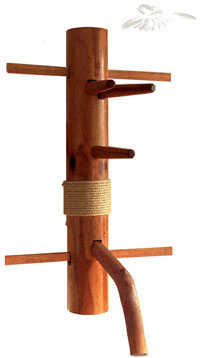

If someone grabs your shirt in a parking lot, closes distance fast, and starts driving forward, the question of wing chun vs bjj for self defense stops being theoretical. You are not comparing logos, traditions, or tournament clips. You are comparing how a training method helps you manage pressure, regain position, disrupt balance, and create a way out.
Both arts can build real skill. Both also have limits. The right choice depends less on internet arguments and more on what kind of self-defense problem you are trying to solve.
Wing Chun vs BJJ for self defense at real range
Self-defense happens at messy ranges. Sometimes an aggressor is just outside striking distance. Sometimes they crash directly into clinch range. Sometimes you are already tied up before you recognize the threat. Any honest comparison has to start there.
Wing Chun is built around close-range striking, forward pressure, angle creation, structural alignment, and contact-based control. It trains you to occupy the center, hit while controlling the opponent’s arms, and use footwork to take away their base. A good Wing Chun practitioner is not just punching fast. They are reading pressure through contact, adjusting line and force, and using simultaneous hand-and-foot coordination to interrupt the attack.
Brazilian Jiu-Jitsu approaches the problem from another direction. Its strength is positional control, clinch engagement, takedowns, escapes, and submissions. BJJ gives students a clear understanding of what happens when a fight turns into grabbing, wrestling, or hitting the ground. That matters because many untrained people rush, grab, and tackle rather than exchange clean strikes.
So which is better? If the goal is to stay upright, strike decisively, control limbs in tight space, and create an exit, Wing Chun offers a direct framework. If the goal is to survive entanglement, reverse bad positions, and control someone once grappling has already started, BJJ has a strong advantage.
Where Wing Chun has a self-defense edge
Wing Chun is often misunderstood as a style that only works under ideal conditions. Properly trained, it is much more specific than that. Its value in self-defense comes from what it prioritizes early – structure, reaction under pressure, and control during contact.
The first advantage is simultaneous defense and offense. In a real confrontation, there is rarely time for a neat block-then-counter sequence. Wing Chun trains you to intercept, redirect, and strike in one action. That shortens decision time. Under stress, simpler timing with fewer beats is a major benefit.
The second advantage is tactile sensitivity. Once hands or arms make contact, visual reaction alone is too slow. Wing Chun develops the ability to feel pressure, direction, and openings through touch. This is useful in clinch-like exchanges where both people are crowding for space. That sensitivity is not abstract. It helps with arm control, line recovery, and balance disruption at the exact range where many assaults begin.
The third advantage is upright mobility. Self-defense is not about winning a prolonged duel. It is about protecting yourself and getting out. Wing Chun’s footwork, angle changes, and body positioning support that objective. If you can break the attacker’s structure, hit from a stable base, and exit before the exchange becomes a wrestling match, you have improved your odds.
This is also why many adults and older teens are drawn to Wing Chun. It does not depend on size alone. It trains leverage, timing, line control, and efficient force. That does not make it magic. It makes it technical.
Where BJJ has a self-defense edge
BJJ deserves respect in any serious self-defense discussion because it addresses a common failure point – what happens when striking range disappears.
A lot of people freeze once they are grabbed hard. They panic when their posture is broken, when they are clinched, or when they hit the floor. BJJ gives a structured answer to those moments. It teaches base, posture, pressure, frames, escapes, reversals, and top control. Those are not small details. They are survival skills if a fight becomes a grappling exchange.
BJJ also has one of the clearest live-training cultures in martial arts. Regular sparring against resisting partners develops timing you cannot fake. Students learn very quickly whether they can actually hold position, escape pressure, or apply control against someone who does not want to cooperate.
For self-defense, that matters most in two scenarios. The first is when you are tackled or dragged down. The second is when you need to restrain rather than strike, such as breaking up a situation with less damage. In both cases, BJJ provides practical tools that many striking systems do not cover deeply enough.
The biggest weakness in each approach
Wing Chun’s weakness is not the system itself. It is incomplete training. If students never deal with real resistance, real entries, real clinch pressure, or realistic takedown threats, their timing can become too cooperative. Good Wing Chun instruction has to pressure-test structure, contact reactions, and footwork against aggressive movement. Without that, technique stays theoretical.
BJJ’s weakness in self-defense is that ground success is not always environmental success. The floor may be concrete. There may be multiple attackers. There may be weapons. A controlling position that works well in sport can become a dangerous place if you are focused on one person while other threats are nearby. Even in a one-on-one encounter, going to the ground voluntarily should be treated carefully.
This is where the debate usually gets oversimplified. People say BJJ is realistic because it spars, or Wing Chun is better because it keeps you standing. Those statements each contain truth, but neither is complete. Real self-defense demands awareness of context.
What matters more than style
If you are choosing between these two arts for practical protection, the school matters as much as the style.
A strong Wing Chun program should teach more than forms and chain punches. It should include pressure-based drills, close-range striking, positional arm control, entry management, balance disruption, and footwork that holds up under forward aggression. Students should learn how to adapt force, not just memorize shapes.
A strong BJJ program should teach more than sport tactics for points or extended ground exchanges. It should address standing engagement, posture against strikes, getting up safely, and the difference between a match and a self-defense incident.
This is why serious beginners should ask a basic question before joining anywhere: how does this school train against resistance without losing technical precision? That answer tells you far more than style labels.
Should you choose Wing Chun or BJJ?
If your priority is striking at close range, controlling the centerline, disrupting an attacker’s base, and staying on your feet while creating an exit, Wing Chun is a strong choice. It is especially appealing if you want a principle-driven system that develops coordination, timing, body structure, and contact reflexes in a focused way.
If your priority is surviving grabs, clinches, takedowns, and ground pressure, BJJ is a strong choice. It gives you a clear map of control when things become messy and physical very quickly.
For many people, the most honest answer is this: Wing Chun is highly valuable for self-defense when taught as a functional close-range combat system, and BJJ is highly valuable when the fight turns into grappling. That is not fence-sitting. That is range awareness.
If you are new to martial arts and want a system built around efficient striking, tactile sensitivity, structural mechanics, and practical close-contact control, Wing Chun offers a distinct path that many people have never experienced properly. At South Florida Wing Chun Kung Fu Academy, that specialized approach is exactly the point. The training is not built around being a generic fitness class. It is built around learning how force, position, timing, and footwork work together.
You do not need to settle the entire wing chun vs bjj for self defense debate before you start training. You need to find honest instruction, train consistently, and understand what your system is meant to do well. If you want to experience how close-range structure, striking, and contact control feel in practice, try out a free class and ask real questions. The right training should make you more capable, not more confused.