
A stance tells you very quickly whether someone can actually use their Wing Chun under pressure. If the feet are too narrow, the body gets uprooted. If the knees collapse, force leaks. If the weight is frozen, movement dies. Good wing chun stance training is not about standing still and looking correct. It is about building a base that can receive force, issue force, and move at the right moment without losing structure.
That difference matters for beginners and experienced martial artists alike. A beginner needs a stance that teaches balance, alignment, and coordination. A more advanced student needs a stance that holds up during contact, stepping, striking, and arm control. In both cases, the goal is the same: efficient body mechanics that support real close-range fighting.
What wing chun stance training is really for
Many people first see Wing Chun stance work as a static exercise. They picture a student holding a position for long periods, knees bent, hips set, elbows in. There is value in that, but only if you understand the purpose. The stance is not the end product. It is the platform that teaches how the lower body supports the upper body.
In Wing Chun, your stance should help you protect your center, maintain pressure toward the opponent, and transition cleanly between receiving and attacking. That means the legs are active, the pelvis is organized, and the spine stays upright without becoming stiff. You are not trying to sink as low as possible. You are trying to create a body position that is stable, mobile, and available for immediate action.
This is where a lot of training goes wrong. Some students overemphasize rooting and become heavy and slow. Others chase speed and become light enough to get pushed off line. The right stance sits between those extremes. It has enough stability to manage incoming force and enough freedom to step, turn, and strike.
Structure first, not appearance
A Wing Chun stance should look simple, but simple is not the same as easy. The feet, knees, hips, spine, and shoulders all need to cooperate. If one part is out of place, the whole structure starts working harder than it should.
The feet create the first conversation with the ground. They should connect you downward without making you rigid. The knees should stay alive and directed in a way that supports the line of force through the body. The hips need to organize the lower body so the torso can remain upright and free. Once that happens, the upper body can strike, redirect, and control without fighting against the legs.
This is one reason stance training matters so much in self-defense. Under stress, people rise up, overreach, and lose their base. If your training has built correct alignment into your habits, your body is more likely to stay organized when things get fast and messy.
The role of the basic stance
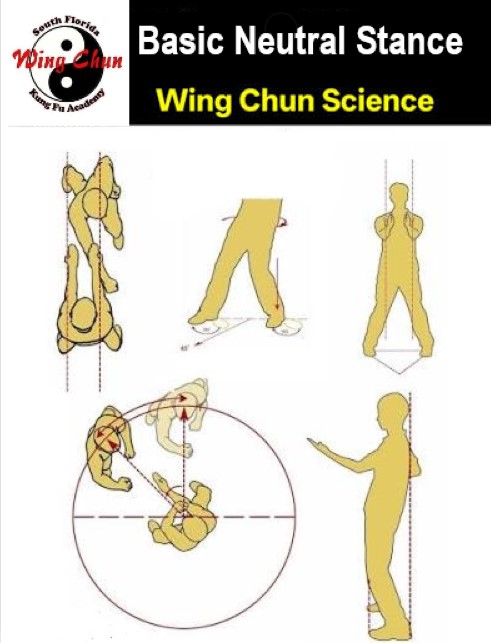
The basic Wing Chun stance is often where students first learn how to connect the body as one unit. It develops awareness of knee position, weight placement, pelvic control, and relaxed upper-body structure. It also teaches patience. You cannot rush the process of learning how to stand correctly while staying relaxed.
Still, the basic stance has limits. If you train it as a shape with no pressure, no stepping, and no timing, it becomes disconnected from application. A good school uses the basic stance as a starting point, then progressively ties it into turning, footwork, striking, and partner contact.
That progression matters because fighting is not static. You will not defend yourself by standing in one place and hoping your structure wins. You need to know how the stance changes when you pivot to create an angle, when you step to recover the line, and when you issue force through the floor into the target.
Wing chun stance training and footwork belong together
A stance without footwork is incomplete. In Wing Chun, the base is not just where you stand. It is how you move without losing your line, your balance, or your ability to attack and defend at the same time.
This is why serious wing chun stance training always develops into stepping drills and angle work. Once you can hold structure in place, you need to keep that structure while moving. That is harder than it sounds. Many students can look stable when they are stationary, then fall apart the moment they step. Their shoulders tense, their weight shifts too far, or their feet land in positions that break their striking line.
Good footwork training fixes that by teaching economical movement. The step should support the hands, not interrupt them. The body should travel as a coordinated unit. When done properly, footwork lets you change range, pressure the opponent’s base, and create better angles for strikes or control. It also lowers the barrier to entry for new students because it gives them a practical way to feel how balance and movement work together.
Why contact changes everything
You do not fully understand your stance until another person puts pressure on it. Solo training is necessary, but partner work reveals whether your structure is functional or just familiar.
As soon as there is contact, small errors become obvious. If your weight is too far forward, you get pulled or redirected. If your hips are disconnected from your upper body, your strikes lose support. If your knees are unstable, your balance breaks during even moderate pressure. Partner drills expose these issues quickly, which is a good thing. They show you exactly what needs work.
This is also where Wing Chun becomes more than posture training. Through controlled contact, students learn how to adapt force, maintain position, and recover structure while exchanging pressure. The stance stops being a fixed pose and becomes an operating platform. That platform supports trapping, arm control, short power, and close-range striking.
Common mistakes that slow progress
Most stance problems are not dramatic. They are small habits repeated often enough to become normal. One common mistake is over-tension. Students try so hard to hold the position that they lock the legs, clench the hips, and stiffen the chest. That creates the appearance of strength while reducing mobility and sensitivity.
Another mistake is collapsing inward. The knees drift, the arch of the foot weakens, and the pelvis loses organization. This usually happens when the student is chasing depth or trying to imitate a shape without understanding how the body should support it.
A third issue is treating stance training as separate from fighting. If you never connect your stance to striking, stepping, turning, and partner drills, progress becomes abstract. The body learns a position but not a skill.
The fix is not complicated, but it requires consistency. Train the shape. Test it with movement. Then test it with contact. That cycle creates real improvement.
How stance training develops power
People often think power comes mostly from the arms and shoulders. In Wing Chun, that is backward. Effective force starts from how the body is organized against the ground and how efficiently that force transfers through the frame.
A solid stance gives your strikes support. It helps you issue force at short range without loading up or telegraphing. It also helps you absorb and redirect pressure without giving away your balance. This is especially important in a close-range system, where exchanges happen quickly and there is not much room to recover from bad positioning.
That said, more rooted does not always mean more powerful. If you become too planted, your force may be stable but late. If you stay too light, your speed may be good but your impact may scatter. Real training teaches when to settle, when to release, and when to step. It depends on range, timing, and the opponent’s pressure.
What beginners should expect
Beginners often feel leg fatigue, balance issues, and general awkwardness during stance work. That is normal. You are asking the body to organize itself in a more disciplined way than it usually does.
The key is not to force progress through strain. Early training should build clean habits first. As alignment improves, endurance and stability follow. Over time, students notice that their movement feels more connected, their strikes feel more supported, and their reactions under pressure become less frantic.
If you are training in a quality class, stance work should not feel isolated from the rest of the system. You should see how it connects to turning, stepping, punching, kicking, and sensitivity drills. That makes the work easier to commit to because you can feel why it matters.
Training with purpose
The best stance training is precise, honest, and practical. It respects details, but it does not get trapped in appearance. It builds a body that can hold position when needed, move when needed, and apply force without wasted motion.
For students interested in real Wing Chun development, this is where a lot of progress begins. A better stance improves balance, coordination, striking structure, and contact response all at once. If you are in Doral, Miami, or nearby South Florida and want to feel how these mechanics work in live instruction, try out a free class and put the training into your own body. A good stance is not something you memorize. It is something you build, test, and keep refining every time you train.