

Most people picture fighting from the outside – wide punches, long kicks, lots of space. But real pressure often collapses that distance fast. That is where close range fighting styles become relevant, because once bodies meet, timing, structure, balance, and arm control matter more than flashy motion.
Close-range systems are built for the moment when there is no room to reset. You are too near for big swings, too entangled for clean retreat, and forced to make fast decisions while under contact. For adults looking for practical self-defense, this range deserves serious attention.
What close range fighting styles are built to do
At close range, the fight changes. The available tools become shorter and more efficient. Elbows, compact punches, low kicks, off-balancing pressure, trapping, clinch entries, and tactile reaction all become more important than long combinations.
That does not mean every close-range method looks the same. Some systems want to crash into a clinch and dominate with body locks or takedowns. Others prefer to strike while controlling the opponent’s arms. Some use head position and shoulder pressure to break posture. Others rely on angle changes and centerline attacks to create a direct path to the target.
The common thread is economy. Large windups are harder to use when someone is already on top of you. A close-range style has to solve immediate problems with short mechanics and stable body structure.
Why close range matters in self-defense
Self-defense is not a sporting exchange where both people agree to start at a safe distance. In many real situations, range disappears before a person is mentally ready. It can happen in a crowded room, near a wall, between parked cars, or during a sudden grab. That is one reason close-range training has practical value.
Another reason is emotional pressure. Under stress, people often tense up, rush forward, or freeze in place. Fine timing at long range becomes harder when adrenaline spikes. Close-range systems that train contact sensitivity, base control, and direct counterattack can give students a more realistic framework for dealing with that pressure.
Of course, close range is not automatically better. If you have room to escape, distance is useful. If the other person is larger and stronger, staying chest-to-chest without skill can become a bad trade. Range is not about ideology. It is about what the situation allows.
Close range fighting styles and their main differences
Some of the best-known close range fighting styles include Wing Chun, boxing infighting, Muay Thai clinch work, wrestling, judo in gripping range, and certain forms of dirty boxing and self-defense combatives. They all operate inside, but they solve the problem differently.
Boxing at close range uses head movement, short hooks, uppercuts, framing, and tight positional awareness. It is highly effective for striking, but it does not usually train prolonged grabbing or limb immobilization the way a dedicated trapping or clinch system might.
Muay Thai thrives in the clinch with knees, posture control, off-balancing, and strong neck ties. It is brutal and efficient, but it often assumes a rule set and stance habits that differ from civilian self-defense.
Wrestling and judo are outstanding for balance disruption and takedowns. They teach pressure, timing, and control against resistance better than many systems. The trade-off is that going to the ground or committing to a throw may not always be the preferred option in a self-defense setting, especially with multiple threats or hard surfaces.
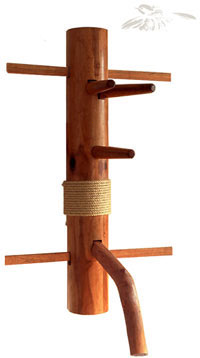
Wing Chun takes a different route. It specializes in striking and controlling from a compact range using forward structure, centerline awareness, simultaneous attack and defense, and quick angle creation. Rather than treating contact as a problem, it turns contact into information. That makes it distinct.
Why Wing Chun stands out among close range fighting styles
Wing Chun is often misunderstood as a style that only works in theory or only belongs in demonstrations. That criticism usually comes from people who have seen choreography without understanding the actual training goals. Proper Wing Chun is not about posing in front of an opponent. It is about learning how to occupy space efficiently, disrupt balance, and apply force through short, coordinated motion.
One of its strongest attributes is simultaneous hand-and-foot coordination. When a student learns to step, strike, and control at the same time, the exchange becomes harder for the opponent to read. Instead of blocking first and hitting later, Wing Chun trains the body to defend and attack as part of one action.
Another important feature is arm control under pressure. At close range, limbs collide. Hands get jammed. Lines disappear. Wing Chun addresses this with drills that develop tactile sensitivity, directional force adaptation, and fast recovery during contact. That kind of training helps students react when visual processing is too slow for the moment.
Structure is another major advantage. Good Wing Chun does not rely on arm strength alone. It uses alignment, stance integrity, and body connection to issue force more efficiently. That matters for smaller practitioners, older students, and beginners who want practical mechanics rather than athletic guesswork.
The mechanics that actually make close-range skill work
A close-range style is only as useful as its training method. Technique names are not enough. What matters is whether the student learns to manage pressure, position, and timing against a resisting body.
First is base control. If you can disrupt the opponent’s balance, even slightly, their power drops and your options improve. This does not always mean a dramatic throw. Sometimes it is a small redirection, a pressure change, or a step that steals alignment.
Second is angle creation. Standing directly in front of force is rarely ideal. Close-range systems work best when they teach students how to shift to a better line while staying connected enough to control the exchange.
Third is force adaptation. Real contact is messy. People push, pull, retract, crash, and stiffen unpredictably. Training that develops sensitivity through touch helps students respond to what is actually there, not what they expected to happen.
Fourth is concise power. Short strikes are not weak if the body is connected. Elbows, palms, vertical punches, knees, and low kicks can all be delivered with sharp force from tight positions when the mechanics are correct.
Who benefits most from this kind of training
Beginners often do well with close-range training because the movements can be taught in a structured, progressive way. You do not need extreme flexibility or a background in athletics to start learning position, reaction, and compact striking.
Experienced martial artists also find value here, especially if they come from long-range systems. Many discover that they are comfortable entering range but less comfortable once the space collapses. Close-range training fills that gap.
This is especially relevant for adults who want realistic self-defense without turning their training into a brawl every session. Technical drills, controlled partner work, footwork development, and progressive pressure can build real skill without relying only on raw aggression.
What to look for in training
If you are evaluating a school that teaches close-range material, watch how they train under contact. Do students learn structure, footwork, and balance, or do they just memorize sequences? Are they taught how to apply pressure with control? Do drills progress from cooperative learning into live timing and realistic resistance?
Look for instruction that explains why a movement works, not just what it looks like. Good coaching should make range, force, and position understandable. It should also welcome beginners while still offering enough depth for serious students.
If Wing Chun interests you, those details matter even more. The difference between shallow imitation and functional training is substantial. A solid program should teach striking, arm control, stepping, sensitivity, and positional mechanics as one connected system.
For students in Doral and the Miami area who want that kind of focused instruction, South Florida Wing Chun Kung Fu Academy offers a technical approach built around practical close-range function. Try out a free class and feel the difference for yourself.
Close-range skill is not about looking impressive from across the room. It is about staying composed when space disappears, using sound mechanics under pressure, and learning how to make small movements count when they matter most.