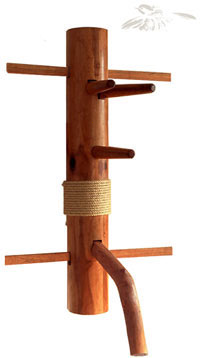


Most beginners do not struggle because Wing Chun is too complex. They struggle because they expect to learn techniques first and structure later. In reality, wing chun kung fu basics for beginners start with body position, pressure, timing, and efficient movement at close range. If those pieces are missing, even simple actions feel awkward. If they are trained correctly, the system begins to make sense very quickly.
Wing Chun is a close-range martial art built around direct lines, coordinated hand-and-foot movement, and the ability to adapt force during contact. That makes it appealing for people who want practical self-defense without relying on large, athletic motions. It also means beginners need to understand that the art is not just a collection of strikes. It is a method of controlling range, disrupting balance, and creating efficient angles while staying stable yourself.
What beginners should understand first
A new student often comes in looking for punches, blocks, or combinations. Those are part of training, but they are not the foundation. The foundation is structure. In Wing Chun, structure refers to how your body aligns so you can deliver force, receive force, and stay balanced under pressure.
This is one reason the art feels different from many striking systems. Instead of reaching, swinging, or loading up power with obvious movement, Wing Chun trains economy. The goal is to move no more than necessary while keeping your body organized. That does not mean passive movement. It means efficient movement.
Beginners also need to understand that contact matters. Many martial arts teach reaction from visual cues alone. Wing Chun develops reaction through touch as well. Once arms make contact, you are not guessing blindly. You are learning to read pressure, redirect force, and attack while maintaining control.
Wing Chun kung fu basics for beginners in class
Your first classes should not feel random. A well-structured program introduces a few core ideas again and again until they become usable under pressure.
Stance and body alignment
The stance is where most students begin, and for good reason. A proper stance helps you keep your balance, generate short-range force, and move without breaking posture. Beginners sometimes mistake stance training for standing still. It is actually about building a stable base that supports striking, stepping, and arm control.
Good alignment also teaches you how to avoid overcommitting. If your chest leans too far, your shoulders rise, or your knees lose position, your power and mobility both suffer. The details matter here. Small corrections in posture can change how much force you can absorb and how quickly you can respond.
Centerline awareness
One of the best-known concepts in Wing Chun is the centerline. For a beginner, the simplest way to understand it is this: the most direct path between you and your opponent matters, and so does your ability to control that path.
This affects offense and defense at the same time. A straight strike delivered with good structure arrives quickly. A hand placed properly on the line can interrupt an incoming attack while creating your own opening. This is why Wing Chun often looks compact. The art favors direct routes over wide motions.
That said, centerline is not a magic answer for every exchange. It works best when paired with angle, footwork, and pressure awareness. If you stand in front of someone without managing distance or position, concept alone will not save you.
Hand shapes and striking mechanics
Beginners usually learn a few basic hand positions early, not because memorizing shapes is the goal, but because each one teaches a mechanical lesson. Some train line control, some train redirection, and some train direct attack. What matters is how the shape functions under pressure.
Striking in Wing Chun is usually short, direct, and connected to the body rather than thrown as an isolated arm movement. If your arm moves independently from your base, the strike loses effect. If your body and hand arrive together, even short power becomes meaningful.
This is where many students get impatient. They want speed before connection. In practice, connection creates real speed because wasted motion disappears.
Footwork and angle creation
Footwork lowers the barrier to entry more than many beginners realize. You do not need to be naturally fast if you learn to step with purpose. Wing Chun footwork teaches you how to adjust range, change angle, and affect the opponent’s base without making your movement obvious.
A common mistake is to think close-range fighting means planting your feet. It does not. Good footwork keeps you stable while letting you enter, pressure, turn, and reposition. It also helps you avoid meeting force head-on when a small angle can solve the problem more cleanly.
At a practical level, beginners should expect plenty of repetition here. Stepping patterns may look simple at first, but their real value appears when they are paired with strikes, arm contact, and directional pressure.
Kicking without sacrificing balance
Wing Chun includes kicking, but not in the flashy sense many people expect. The kicks are generally practical, direct, and tied to range and structure. A beginner is better served by learning how to kick without losing balance than by trying to kick high or hard too early.
Low-line kicks can disrupt stance, interfere with stepping, and open the way for hand control. They work best when integrated with the rest of the system. If a kick causes your posture to collapse or disconnects your upper and lower body, it creates as many problems as it solves.
Why tactile sensitivity training matters
One of the defining parts of Wing Chun training is tactile sensitivity. For beginners, this can sound abstract until they actually feel it. Once contact is made, you begin learning how to detect pressure, gaps, resistance, and changes in intent through touch.
This is not mystical. It is trained through controlled drills that build reaction timing and force adaptation. Instead of freezing when someone pushes, redirects, or changes angle, you develop the ability to adjust in real time.
That has obvious self-defense value. In close range, visual processing can lag behind physical contact. Tactile training helps bridge that gap. It also improves your ability to control arms, maintain position, and strike while dealing with pressure rather than waiting for a perfect opening.
What beginners usually get wrong
Most early mistakes are not dramatic. They are small mechanical habits that limit progress. Some students try to use arm strength instead of whole-body structure. Others chase speed and neglect balance. Some become too stiff because they are trying so hard to do everything correctly.
Another common issue is treating drills like choreography. Drills are not there to make movements look polished. They are there to develop timing, position, and adaptability. If you perform a sequence perfectly in the air but lose structure as soon as contact is introduced, the training has not done its job yet.
Patience matters here. Wing Chun is technical. That is a strength, not a drawback. The details are what make the system practical, but they need time under qualified instruction.
What to expect from good beginner training
A good beginner program should feel focused, not overwhelming. You should learn how to stand, step, strike, and maintain contact pressure before being buried under too many techniques. You should also get hands-on correction. Wing Chun is not learned well from explanation alone. Body mechanics have to be felt and refined.
You can also expect a mix of solo and partner training. Solo work builds posture, coordination, and movement discipline. Partner work teaches distance, timing, and force adaptation. Both are necessary. If one is missing, development becomes lopsided.
For adults and older teens interested in practical skill, this is one of the major advantages of structured Wing Chun training. You are not just memorizing forms or trying to out-athlete someone. You are learning how mechanics, pressure, and position work together in a coherent system.
Is Wing Chun right for you?
That depends on what you want. If you are looking for a highly acrobatic style or a casual fitness class with a martial arts theme, Wing Chun may not be the right fit. If you want a disciplined system that emphasizes close-range self-defense, efficient striking, arm control, coordinated footwork, and technical depth, it is worth serious consideration.
At South Florida Wing Chun Kung Fu Academy, beginners are introduced to these mechanics in a structured, approachable way so they can build real skill instead of collecting random techniques. Try out a free class and feel the difference for yourself.
The best first step is not trying to understand everything at once. It is training the fundamentals until your stance feels stable, your movement feels connected, and contact no longer feels chaotic.