
A fight changes the moment distance disappears. At long range, you have time to read movement, reset your stance, and choose your next action. At close range, that time shrinks fast. A close quarters fighting style is built for that reality. It trains you to strike, control, and reposition while the other person is already within arm contact, where structure, timing, and pressure matter more than flashy movement.
For many people, this is where martial arts starts to feel practical. Real confrontations rarely look like clean sparring at a safe distance. They get crowded, messy, and physical. That is why close-range systems deserve serious attention, especially for students who want self-defense skills rooted in mechanics rather than guesswork.
What makes a close quarters fighting style different?
A close quarters fighting style is designed to operate inside a compressed range where both people can touch, strike, trap, redirect, or off-balance each other with very little space. Instead of relying on wide swings or long entries, it emphasizes efficient angles, direct lines, short power, and constant positional adjustment.
That does not mean every close-range system looks the same. Some arts approach close contact through clinch fighting and takedowns. Others prioritize short striking and arm control. Some use heavy pressure and body contact, while others focus on sensitivity and interception. The common thread is that they all solve the same problem: how to stay effective when there is no room to waste motion.
This is also where technique gets exposed quickly. If your balance is weak, close range will reveal it. If your hands and feet do not work together, close range will reveal that too. If your posture collapses under pressure, you will feel it immediately. A good close-range system develops structure so your offense and defense can happen at the same time.
Why close-range mechanics matter in self-defense
Self-defense is often discussed in broad terms, but range changes everything. A person who grabs, rushes, crowds, or swings from close distance creates a different problem than someone standing several feet away. In that space, reaction time is shorter, visual cues are smaller, and body contact becomes a major source of information.
That is why a close quarters fighting style should train more than striking alone. You need to understand pressure, balance disruption, hand position, centerline control, and footwork that creates angles without overcommitting. The goal is not to trade force recklessly. The goal is to manage contact in a way that protects your base while damaging or disrupting the other person’s ability to continue.
There is also a practical trade-off here. Close-range training can be highly realistic, but it demands precision. Students cannot rely on speed alone. They need repetition, partner feedback, and technical correction. For beginners, that can feel more demanding than pad work or simple combinations. The upside is that the skills tend to become more functional under pressure because they are built around contact, not just appearance.
Key traits of an effective close quarters fighting style
The first trait is economy of motion. In close range, extra movement costs time and opens lines. Efficient systems keep actions compact and purposeful. Strikes travel short paths. Defensive motions are also attacks when possible. Recovery is immediate because there is no room to admire what just happened.
The second trait is structure. Good close-range mechanics are not just about being aggressive. They depend on alignment through the feet, hips, torso, and arms so force can be delivered without overreaching. Structure also helps absorb and redirect incoming pressure. If you are upright but disconnected, your body becomes easy to move. If your structure is organized, you can remain stable while changing angle and applying force.
The third trait is tactile sensitivity. At close contact, you cannot depend on sight alone. You must feel pressure changes, openings, and intent through touch. This is one of the most overlooked parts of practical training. Sensitivity is what allows a fighter to adapt in motion instead of freezing when the initial plan breaks down.
The fourth trait is coordinated footwork. People often think close-range fighting means standing still and using only the hands. That is a mistake. Footwork is what controls range, alignment, and angle. Even a small step can break the opponent’s line, recover your base, or set up a clean opening for strikes and control.
Wing Chun as a close quarters fighting style
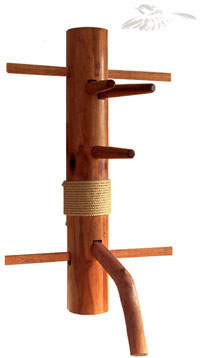
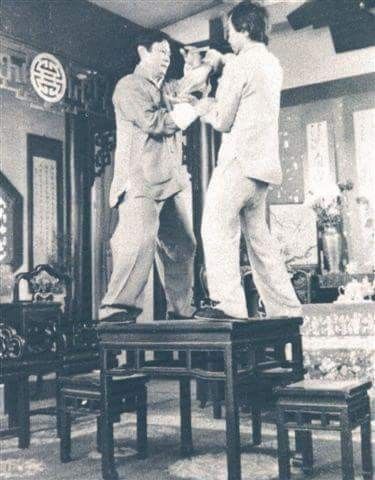
Wing Chun is one of the clearest examples of a close quarters fighting style because its training is organized around direct entry, centerline awareness, simultaneous attack and defense, and close-contact adaptation. It is not simply about punching fast at short range. It is a system built to manage the exchange when bodies, arms, and balance are already interacting.
Its logic is straightforward. If the opponent occupies the space in front of you, you do not need large movements to respond. You need clean angles, stable posture, and fast decisions. Wing Chun uses these principles to control the line of attack, create pressure through the hands, and apply force with support from the stance and stepping.
A strong Wing Chun program also goes beyond memorized forms. It develops timing through partner drills, reaction through tactile exercises, and power through body mechanics. Students learn how to strike while controlling the opponent’s arms, how to shift position without giving up balance, and how to create openings through pressure rather than chasing them.
This is one reason Wing Chun appeals to both beginners and experienced martial artists. Beginners can start with accessible mechanics and a clear training structure. More advanced students can spend years refining sensitivity, angle creation, and explosive short-range force.
The role of contact training
If a school claims to teach close-range fighting but avoids consistent partner contact, something is missing. You cannot understand close quarters by shadowboxing alone. You need to feel resistance, pressure, collapse, and recovery in real time.
Contact training teaches distance in a way that mirrors actual confrontation. It shows whether your arms are too wide, whether your weight is drifting, and whether your footwork supports your hands. It also teaches emotional control. Students begin to stay calmer under pressure because close contact stops feeling unfamiliar.
That said, contact training should be structured, not reckless. Good instruction builds skill progressively. Beginners need enough pressure to learn, but not so much that they turn every drill into a brawl. The best schools know how to scale intensity while preserving technical quality.
Common misunderstandings about close-range fighting
One common misunderstanding is that close-range fighting is just trading punches in the pocket. In reality, the best close-range systems do not stay square and absorb damage unnecessarily. They seek control. They intercept, redirect, jam, off-balance, and strike from positions that reduce the opponent’s ability to answer back.
Another misunderstanding is that short-range systems ignore the lower body. In fact, the lower body is essential. Your feet determine whether you can angle out, stabilize impact, or pressure forward without losing balance. Short kicks, stepping actions, and base control are all part of effective close-range work.
There is also the idea that close-range skill is useful only for smaller spaces. That misses the point. Even if a confrontation starts farther out, many exchanges collapse inward quickly. Training for close quarters prepares you for a phase of fighting that appears often, whether you intended it or not.
Who benefits most from this kind of training?
Adults looking for practical self-defense often benefit because the training focuses on efficiency rather than athletic flash. Older teens who want disciplined skill development also do well with this approach, especially if they are drawn to technical detail and structured progression.
Experienced martial artists can benefit too, particularly if they come from systems that spend more time at long range. A close quarters fighting style can sharpen their understanding of hand control, pressure, recovery, and compact power. It fills in gaps that become obvious once distance disappears.
For students in Doral and the Miami area who want a specialized martial art instead of a general fitness class, Wing Chun offers a focused path. At South Florida Wing Chun Kung Fu Academy, that path is taught through hands-on instruction that emphasizes mechanics, contact, and functional application. If you have questions, come ask. Better yet, try out a free class.
How to judge whether a school teaches real close-range skill
Look at how the school trains, not just how it talks. Are students learning to coordinate hands and feet, or are they only repeating isolated motions? Is there partner work that develops timing and tactile response? Are instructors correcting structure, balance, and line control, or just encouraging speed?
You should also pay attention to how clearly the school explains why a movement works. Technical depth matters. A school that can explain force direction, body alignment, angle creation, and positional control is usually giving students something they can build over time.
The right close-range training does not promise magic. It gives you a method. It teaches you how to stay organized when space is tight, pressure is real, and quick decisions matter. That kind of skill takes work, but it is worth building if you want martial arts that hold up when distance disappears.