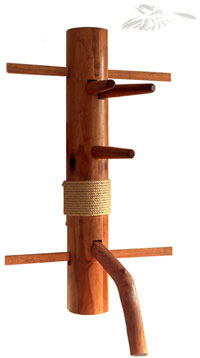

If you are looking at south florida wing chun kung fu, you are probably not just shopping for another workout. You want training that teaches you how to manage pressure, control range, and use efficient mechanics when space gets tight. That is where Wing Chun stands apart. It is a close-range system built around timing, structure, angle, and coordinated force, not wide movements that fall apart under contact.
For many adults and older teens, that difference matters right away. A lot of martial arts programs sell variety. Wing Chun asks for focus. Instead of trying to be everything at once, it develops a specific set of fighting skills through direct training methods that sharpen reaction, balance disruption, hand-foot coordination, and tactile awareness.
What Makes South Florida Wing Chun Kung Fu Different
Wing Chun is often described as a striking art, but that is only part of the picture. Good training includes striking, yes, but also contact control, pressure management, positional awareness, and the ability to adapt force when arms connect. That contact element changes everything. Once an exchange collapses into close range, speed alone is not enough. You need structure that supports your force, footwork that keeps your base under you, and the ability to feel openings rather than chase them.
This is one reason Wing Chun attracts people who want practical self-defense instead of performance-based movement. The system is designed to work in the kind of range where people actually collide, jam, grab, and try to overwhelm each other. It trains the body to respond with economy. That means shorter lines, less wasted motion, and better use of timing.
It also creates a more technical learning experience. Beginners can start with simple shapes and stepping patterns, but the art keeps opening up as skill improves. A new student may first learn how to align the body behind a straight punch. Later, that same student learns how to control an incoming arm, shift angle, pressure the opponent’s base, and strike while moving into a stronger position. The principles stay consistent even as the application becomes more advanced.
Why Close-Range Mechanics Matter
A lot of people imagine self-defense as a clean exchange at comfortable distance. Real pressure is rarely that cooperative. Range collapses. Arms clash. Balance gets challenged. Your first shot may not end the problem. When that happens, close-range mechanics decide whether you can keep functioning.
Wing Chun trains for that moment. The system emphasizes centerline control, simultaneous attack and defense, and force delivery from a stable structure. Instead of thinking in separate categories like block first and hit later, the training teaches you to do both together when possible. That is not magic and it is not about flashy speed. It is about efficiency.
Footwork plays a major role here. Good Wing Chun is not stationary. It uses stepping to create angle, regain alignment, pressure forward when needed, and reduce the opponent’s ability to set their own force. If your feet are wrong, your hands usually follow. If your base is stable and mobile, your options improve fast.
This is also where the art becomes more accessible than many people expect. You do not need extreme flexibility or athleticism to begin. You do need patience and consistency. Wing Chun rewards attention to detail. A small correction in stance, elbow position, or stepping angle can make a noticeable difference in power and control.
How Training Usually Progresses
The best south florida wing chun kung fu programs do not throw beginners into chaos. They build skill in layers. First comes body organization. Students learn stance, alignment, basic strikes, guarding positions, and how to move without losing balance. That foundation is not glamorous, but it matters. Without it, speed turns sloppy and power leaks away.
From there, training becomes more interactive. Drills teach students how to respond when contact is made on the arms. This develops tactile sensitivity, sometimes called the ability to read pressure through touch. That skill helps you identify when an opponent is resisting, collapsing, overcommitting, or leaving a gap. Instead of guessing, you begin to feel when to strike, redirect, or change angle.
As students improve, they work more on entry, control, and force application. This can include trapping concepts, arm control, short power, and positional pressure that affects the opponent’s balance. Kicking is part of the system too, but in a practical sense. Wing Chun generally favors efficient, lower-line kicks that support position and timing rather than high-risk flash.
There is a trade-off here that serious students should understand. Wing Chun is specialized. That is a strength, but it also means the school has to teach the art honestly. If a program waters it down into generic cardio drills, students miss what makes the system effective. On the other hand, if instruction is so abstract that beginners cannot apply anything, people get frustrated. Good teaching bridges both worlds. It keeps the method technical while making each lesson usable.
What Beginners Should Look For in a School
A quality school should be able to explain not just what a movement looks like, but why it works. If an instructor talks clearly about structure, angle, pressure, and timing, that is a good sign. If every answer is vague or mystical, that should raise questions.
You should also look at how students train with each other. Are they developing controlled contact skills, or are they just performing sequences in the air? Wing Chun needs hands-on practice. That does not mean reckless sparring from day one. It means students should be learning how to apply mechanics against real pressure in a progressive way.
The atmosphere matters too. Serious martial arts training should feel disciplined, but it should also feel approachable. Beginners need room to ask questions and build confidence. Experienced practitioners need technical depth. A good school can do both at once.
For people in Doral, Miami, and the surrounding South Florida area, that local access makes a practical difference. Consistency is what builds skill. A specialized school close enough to attend regularly is more valuable than a program that sounds impressive but is hard to fit into real life.
Why Wing Chun Appeals to Both New and Experienced Students
Beginners often come to Wing Chun because they want self-defense that makes mechanical sense. They like that the art does not depend on high kicks, acrobatics, or brute force. They can feel progress in posture, coordination, and reaction speed even early in training.
Experienced martial artists often come for a different reason. They want refinement. They want to understand how close-range pressure really works, how to generate force in short space, and how to control an opponent without relying on bigger motions. Wing Chun gives them a system where details matter. Elbow position matters. Base control matters. The timing of a step matters.
That said, prior experience can help or hinder. Some students adapt quickly because they already understand discipline and repetition. Others need time to let go of habits built for a different range or rhythm. That is normal. Wing Chun is principle-driven, and those principles have to be felt through training, not just memorized.
Training for More Than Technique
The value of Wing Chun is not limited to fighting skill. Consistent practice improves posture, balance, hand-eye coordination, and calm under pressure. It teaches students to stay organized when things get messy. That carries over beyond class.
There is also a mental benefit to technical training. When a school teaches clearly and progressively, students learn how to solve physical problems with structure instead of panic. They become more deliberate. More aware. More confident without needing to act tough.
At South Florida Wing Chun Kung Fu Academy, that kind of development is part of the point. The goal is not to collect random techniques. The goal is to build a functional system in the body through structured practice, honest contact, and repeatable mechanics.
If you have been thinking about starting, the best next step is simple. Try a class. Feel what close-range training is actually like, ask questions, and see whether the instruction makes sense in your hands and feet, not just on paper. The right school should leave you challenged, clearer, and ready to come back. Come join us today!