
A self-defense situation rarely begins with a clean fighting stance or enough room to throw a perfect punch. It often starts with uncertainty: someone crowding your space, grabbing an arm, blocking your path, or forcing you to react before you feel ready. The best self defense skills are the ones that help you recognize danger early, protect your balance, create space, and leave safely.
That does not mean memorizing a long catalog of dramatic techniques. Reliable self-protection comes from simple actions trained until they remain available under stress. Physical skill matters, but so do awareness, decision-making, and the ability to control distance when another person is close enough to touch you.
What Makes a Self-Defense Skill Useful?
A useful skill must work when your heart rate is high, your view is limited, and your body is not perfectly positioned. It should not depend on an opponent cooperating or on you being stronger, faster, or more athletic than the person in front of you.
For adults and older teens, the priority is not winning an exchange. The priority is avoiding the exchange when possible, interrupting an immediate threat when necessary, and creating a path to safety. Training should build posture, footwork, coordination, reactions, and judgment together.
1. Awareness and Positioning
Awareness is the first layer of self-defense because it gives you time. Notice who is around you, where the exits are, whether someone is closing distance unnecessarily, and whether a situation is changing from uncomfortable to unsafe. This is not about living in fear. It is about staying present enough to make decisions before you are trapped in a bad position.
Positioning turns awareness into action. Keep a reasonable distance from unfamiliar people who make you uneasy. Avoid allowing yourself to be cornered between a wall, vehicle, table, or group. If someone approaches aggressively, move toward an open route rather than backing straight into an obstacle.
Your hands can stay visible and nonthreatening while still protecting you. Holding them naturally in front of your body creates a barrier and shortens the time needed to respond. Clear verbal boundaries such as “Stop,” “Back up,” or “I don’t want trouble” can also draw attention and establish that you are trying to disengage.
2. Balance and Base Control
A person who loses balance loses options. If your feet are too narrow, crossed, or planted heavily, a push, pull, or sudden grab can take away your ability to move. A stable base gives you a platform to strike, turn, resist being dragged, or move toward an exit.
Good balance is active, not rigid. Keep your knees relaxed, your weight organized under your body, and your feet positioned so you can step without first having to recover. Avoid leaning far forward into another person or pulling yourself backward with your upper body. Either error makes it easier for someone else to control your center.
Base control is especially valuable at close range, where strength alone is unreliable. When contact occurs, learn to feel where pressure is being applied and adjust your feet rather than trying to fight every force with your arms. A small angle change can reduce an opponent’s ability to drive directly into you.
3. Footwork That Creates an Exit
The best self defense skills include footwork because staying in place is rarely the answer. Footwork lets you manage distance, change angles, and avoid standing directly in front of an attacker’s strongest line.
Start with simple movement: step back to make space, step to the side to clear a direct path, and turn your body toward an exit. Do not cross your feet when you need to move quickly. Crossing can tangle your base and make you easier to shove or trip.
There is a trade-off here. Moving backward may create distance, but it can also lead you into walls, furniture, or other people. Side movement can open an escape route, but only if you remain aware of your surroundings. Effective training teaches you to move with purpose rather than simply retreating blindly.
4. Protecting Your Head and Centerline
When a threat becomes physical, protect the targets that matter most. Keep your chin from lifting, avoid reaching your face toward the person, and maintain your arms between your center and the incoming threat. This is not a frozen guard. It is a structure that helps you defend while moving.
At close distance, wide swinging motions are often slow and difficult to control. Compact hand positions and short movements are more practical when space is limited. They can shield your head, redirect an arm, and help you maintain contact long enough to move away.
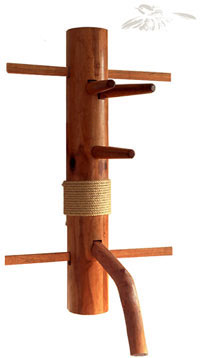
Wing Chun training places strong emphasis on the centerline, the direct line between you and another person. Understanding that line helps students recognize where pressure is coming from and where their own hands and feet need to work. The goal is not to pose in a particular shape. It is to keep your body organized while the situation is changing.
5. Close-Range Arm Control
Many confrontations involve grabbing, pushing, holding, or repeated attempts to control your arms before they involve clean punches. That is why close-range arm control is one of the most practical areas to train.
Rather than relying only on pulling away, learn to use body position, angles, and contact sensitivity. If someone grabs an arm, the response may involve turning your body, stepping to change the line of force, controlling the grabbing limb, and leaving. The exact answer depends on the grip, the available space, and whether there is a clear escape route.
Training with a resisting partner matters. A technique that feels easy when someone holds still may fail when they pull, push, change hands, or use their body weight. Partner drills teach you to recognize pressure and adapt instead of trying to force a rehearsed response.
6. Simple, Direct Striking Mechanics
Striking can be necessary when there is no safe way to disengage and an immediate threat must be interrupted. The useful question is not how many strikes you know. It is whether you can deliver a direct, balanced action without losing your footing or extending yourself into danger.
Close-range striking should connect the hand, body, and feet. Power does not come only from arm strength. It comes from alignment, forward intent, stable structure, and coordinated movement. Short, efficient actions are often more realistic than large techniques that require distance and perfect timing.
Striking is not a guarantee, and it carries consequences. A larger attacker may absorb a hit, a strike may miss, or the situation may escalate. This is why striking should be trained as part of a broader response that includes movement, control, and escape, not as a stand-alone solution.
7. Tactile Sensitivity and Adaptation
Vision can be unreliable in a crowded space, low light, or a sudden struggle. When arms are in contact, tactile sensitivity helps you feel changes in pressure, direction, and openings. This is a specialized skill, but it has direct self-defense value because close-range conflict is often messy and fast.
Sensitivity training teaches you not to overreact to every push or pull. If pressure comes forward, you may redirect and angle away. If pressure releases, you learn not to fall into empty space. Over time, this develops calmer reactions and better force adaptation.
Wing Chun uses structured contact drills to develop these qualities alongside footwork, striking, and arm control. At South Florida Wing Chun Kung Fu Academy, students work on the mechanics behind these responses: maintaining a base, creating angles, coordinating hands and feet, and applying force efficiently under pressure.
Training Turns Knowledge Into Skill
Reading about self-defense can improve your understanding, but it cannot give you timing, distance, or contact awareness. Those qualities come from regular practice with qualified instruction and training partners who gradually add movement, resistance, and realistic pressure.
A good class should make beginners feel challenged without being overwhelmed. You should learn why a movement works, where it applies, and where it may fail. You should also have time to repeat the basics until your posture, footwork, and reactions become more dependable.
Start with the skill that supports every other one: paying attention to your space and keeping your balance when someone enters it. From there, disciplined training can turn uncertainty into practical capability. If you want to experience close-range self-defense training firsthand, come join us today and try out a free class.