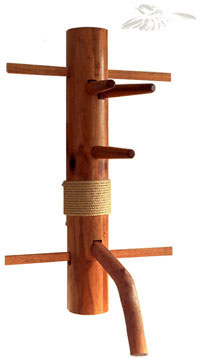

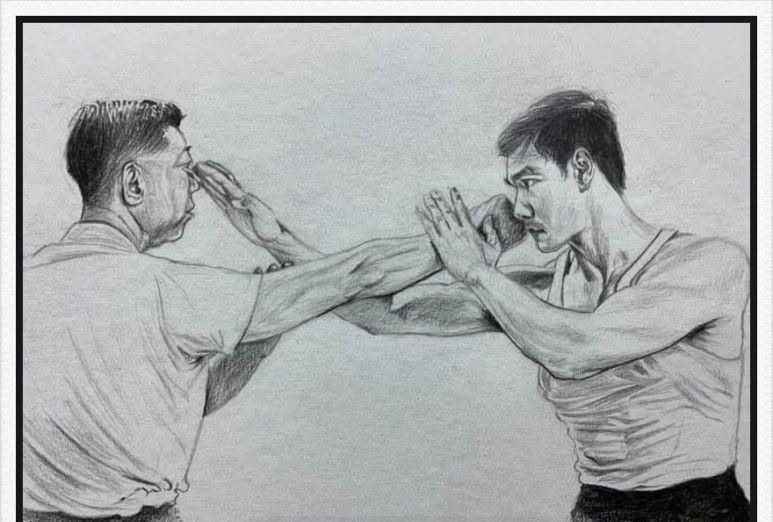
A lot of people imagine power as a big swing from far away. In actual close-contact fighting, that idea breaks down fast. Close range striking mechanics are built on a different set of rules – structure over windup, angle over reach, and coordinated pressure over isolated arm speed.
This is one reason Wing Chun stands apart for practical self-defense. At close range, there is very little room to recover from wasted movement. If your elbow drifts, your stance rises, or your strike disconnects from the floor, you lose force and position at the same time. Good mechanics let you hit while controlling the exchange, instead of trading shots and hoping your hand lands first.
What close range striking mechanics really mean
At short distance, striking is not just about the hand that hits. It is about how the body organizes force through the ground, the legs, the hips, the spine, and the arms in one connected action. The strike may look small, but the whole body is involved.
This is where beginners often get confused. They see a short punch and assume it uses less power because it travels a shorter path. In reality, short-range striking can be extremely disruptive when the body alignment is correct. The force does not come from a big chamber. It comes from timing, body unity, and positional advantage.
In Wing Chun, this is tied closely to centerline control and occupying space efficiently. The goal is not to throw flashy techniques. The goal is to strike from a position that limits the opponent’s ability to do the same.
Structure comes before speed
One of the biggest mistakes in close-range fighting is trying to be fast without being organized. Speed matters, but unsupported speed often collapses on contact. If the wrist bends, the elbow flares, or the shoulder lifts, the strike loses integrity right when resistance appears.
Good structure means the joints are aligned so force can travel cleanly. The wrist supports the hand, the elbow supports the line of attack, and the shoulder stays connected rather than reaching. Lower in the body, the knees and hips must remain active enough to support pressure without becoming stiff.
There is a trade-off here. If you become too rigid in the name of structure, you slow down and become easy to read. If you become too loose, your strikes lack penetration. The right balance is stable but alive. You need enough firmness to deliver force and enough adaptability to adjust during contact.
Why the elbow matters so much
In close-range systems, elbow position is one of the clearest signs of skill. When the elbow stays behind the strike and supports the line, force transfers more directly. When it drifts wide, the arm becomes disconnected and easier to jam, deflect, or trap.
This is also why many Wing Chun movements look compact. Compact does not mean weak. It means the motion is trimmed down to what the range actually allows.
Footwork is part of the strike
People often separate striking from footwork, but at close range they are inseparable. Your feet determine whether your strike has support, whether your angle is open, and whether your opponent can recover balance.
A short strike becomes much more effective when paired with a small step, pivot, or pressure change. That footwork can shift your center, turn the opponent’s line, and add force without making the movement obvious. Instead of chasing power with the shoulders, you build it from the floor and direct it through the target.
This matters even more against a resisting person. If both people are touching and adjusting, the better striker is usually the one who can change angle while preserving balance. Standing square and throwing hands is rarely enough. You need to move the body into a stronger position as you strike.
Angle creation at close contact
At long range, angle changes can be wide and visible. At close range, they are tighter. A small pivot or step can change the entire exchange. Suddenly your strike has a line while the other person is jammed, turned, or forced to reset.
That is one of the practical strengths of Wing Chun training. Students learn to create useful angles without needing large evasive movement. This makes the system accessible for beginners while still offering technical depth for experienced martial artists.
Contact changes everything
Close-range striking is not clean, isolated hitting. Arms clash. Frames form. Hands stick, press, redirect, and feel for openings. Because of that, tactile sensitivity becomes a major part of effective mechanics.
If you only know how to strike in open space, you may fall apart once someone makes contact and disrupts your rhythm. But if you are trained to read pressure through the arms and body, you can adapt in real time. A blocked strike can become a control. A control can become a strike. The transition is where skill shows up.
This is why sensitivity training matters. It teaches you not to panic when contact happens. Instead of forcing a preplanned move, you learn to respond to pressure, gaps, and shifts in balance. That makes your striking more efficient because you stop fighting the wrong battle.
Power at short range is about timing, not effort
Many people use too much muscle when they first work on close-range power. They tense the shoulders, push from the chest, and try to make the strike happen through effort alone. The result is usually slow, telegraphed, and easy to absorb.
Better short-range power comes from coordinated release. The body settles, connects, and delivers force at the right moment. There is no big preparation phase. The strike happens from where you are, using alignment and timing rather than visible loading.
This does not mean effort disappears. It means effort is directed more intelligently. You still need intent, commitment, and pressure. But the body must apply them in sequence. If one segment moves too early or too late, the strike leaks energy.
Simultaneous attack and control
Another key point in close range striking mechanics is that striking and controlling often happen together. You may strike while occupying the center, checking an arm, or taking away the opponent’s base. This is more efficient than treating offense and defense as separate turns.
That said, it depends on the moment. Sometimes trying to do everything at once makes the action weak. A skilled practitioner knows when to prioritize clean impact, when to prioritize control, and when both can happen together.
Common problems that limit close-range striking
Most technical errors come from overreaching or overcommitting. People lean instead of stepping. They swing instead of aligning. They chase the head and lose their base.
Another common issue is striking without understanding range transitions. The distance between trapping, framing, and hitting is small. If you misread it, your strike can jam against the target or collapse under pressure. Training should teach you how to recognize when to punch, when to clear, and when to reposition.
Breathing also affects mechanics more than most people realize. If you hold tension in the chest and neck, your movement stiffens. Controlled breathing helps preserve mobility and keeps the body from overloading under pressure.
How Wing Chun develops these mechanics
Wing Chun builds close-range striking through repetition, partner drills, stance and stepping work, and controlled contact training. The point is not just to memorize techniques. It is to develop body organization that holds up when timing gets messy.
Students work on keeping the elbows connected, generating force without wide loading, coordinating hand and foot action, and responding to contact instead of freezing under it. Over time, the mechanics become less theoretical and more instinctive.
For beginners, this approach gives a clear framework. For more experienced martial artists, it often reveals how much close-range efficiency depends on details that are easy to overlook. At South Florida Wing Chun Kung Fu Academy, that technical side of training is treated as the core of practical skill, not an optional extra.
Why this matters for self-defense
Self-defense is rarely neat. Space can be limited. Reactions happen fast. You may not have room for long combinations or wide defensive movements. That is where close-range striking mechanics become practical, not just interesting.
If you can stay organized under pressure, strike from compact positions, and adapt during contact, you have a much better chance of controlling the exchange. Not because you are stronger, but because your movement wastes less and connects more.
That kind of skill takes training, but it is trainable. If you want to understand how close-range force, footwork, and contact-based reactions really work, try a free class and feel the difference for yourself.