
When someone gets a solid bjj head and arm control on you, the problem is not just pressure. The real issue is that your posture, turning ability, and base start failing at the same time. Once your head is pinned and one arm is isolated, your options shrink fast. That is why this position matters so much in grappling, and why understanding its mechanics can improve your overall control, escapes, and close-range awareness.
For students interested in practical combat mechanics, this position is worth studying beyond the usual submission focus. Head-and-arm control teaches a bigger lesson – if you can dominate the head and one side of the body, you can often steer the whole person. That idea applies in Brazilian Jiu-Jitsu, and it also connects to broader concepts of pressure, angle, and body structure seen across effective martial systems.
What bjj head and arm control really does
At a surface level, head and arm control seems simple. You trap the head and one arm together, apply chest pressure, and limit movement. But the real value is in what it removes from your opponent.
The head directs balance. The arm helps frame, post, and recover space. When both are tied up together, the defender usually loses the ability to turn cleanly into you, build a strong frame under your neck, or create enough distance to recover guard. This is why the position shows up so often from side control, mount transitions, and submission chains.
The mistake many newer grapplers make is treating it like a static hold. They squeeze hard, burn their arms out, and assume the position is secure because it feels heavy. Against a skilled opponent, that approach breaks down. Good control is less about muscular effort and more about wedge placement, shoulder alignment, hip position, and timing.
The structure behind head and arm control
The strongest version of this control is built from connection, not reach. If your arms are extended, your chest is floating, or your hips are too far away, the defender can usually start inserting frames and turning onto their side.
Your shoulder line should help pin the head while your torso occupies space the opponent wants to reclaim. Your body needs to close gaps rather than chase limbs. In practical terms, that means bringing your weight through your center, staying compact, and using your ribs, chest, and shoulder as controlling surfaces.
This is where many martial artists start to recognize a familiar principle. Efficient control comes from body unity. If your hands are working separately from your stance and torso, you are fighting with disconnected parts. If your pressure is traveling through your whole frame, your control becomes harder to escape and easier to maintain.
That same idea matters in close-range striking and trapping as well. Control is strongest when the body acts as one piece.
Why pressure alone is not enough
Heavy pressure can make someone uncomfortable. It does not always make them controlled.
A common problem in bjj head and arm control is overcommitting weight forward without managing angle. You may feel dominant for a moment, but if your opponent gets an underhook, turns toward their knees, or catches your balance as you adjust, the position starts slipping away. Pressure without directional awareness can create openings.
Good grapplers apply pressure with purpose. They pressure the head to stop turning. They control the trapped arm to kill frames. They angle their hips to reduce space near the defender’s elbow line. They stay ready to switch between holding, advancing, and attacking.
This is one of the trade-offs in top control. If you focus only on pinning, you may lose submission timing. If you rush the finish, you may give up the pin. The answer is not picking one or the other. The answer is learning when the opponent’s structure is truly compromised enough to progress.
Common entries into the position
Most students first encounter this control from side control, especially after flattening an opponent who tried to frame or turn in. It also appears during passing exchanges when the top player clears the knees and immediately catches the head-and-arm relationship before the bottom player can rebuild guard.
Another common entry comes from mount transitions. If the bottom player reaches awkwardly to push, bench-press, or expose an elbow, the top player can isolate that arm while collapsing the head position. From there, the path may lead to tighter control, a mounted attack, or a submission sequence.
There is also a more transitional use of the position that often gets overlooked. Sometimes head and arm control is not the final destination. It is a checkpoint. It lets you stop movement long enough to adjust your base, walk to a stronger angle, or force a predictable defensive reaction.
That mindset is useful for self-defense-oriented students. In real movement, control often happens in stages. You do not always land in a finished position. Sometimes you establish enough contact to slow the opponent, break alignment, and move to a better advantage.
Where students usually go wrong
The first mistake is chasing the head with the arms instead of moving the body into place. This creates reaching, loose elbows, and fatigue.
The second is staying too high. If your weight is concentrated near the shoulders without controlling the near hip or lower body angle, the defender may still be able to bridge, shrimp, and recover. Head control matters, but the rest of the body is still part of the escape.
The third mistake is ignoring the trapped arm once it is initially secured. That arm is not just decoration inside the hold. It is a lever. If the defender frees the elbow line or turns the forearm into a frame, the quality of control changes immediately.
Finally, many students become predictable. They hold the same pressure, in the same direction, for too long. Skilled grapplers read that rhythm. Strong control often feels patient, but it is not passive. It keeps making small adjustments before the defender can build momentum.
Escaping teaches control too
One of the fastest ways to improve your top pressure is to understand what the bottom player needs.
A person stuck under head and arm control usually wants to recover head movement, free the elbow, turn onto a side, or insert a frame that reconnects the arms to the torso. If you know those goals, you can feel the early signs of each escape before it develops.
This is where tactile sensitivity becomes important. The best control is not just mechanical. It is responsive. You should be able to feel when pressure needs to increase, when an angle needs to shift, and when the opponent’s frame is about to form.
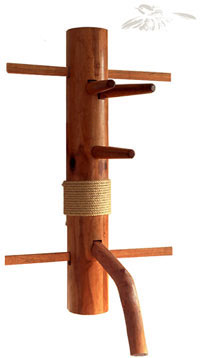
That sensitivity is one reason cross-training concepts can be so valuable. In Wing Chun, close contact training develops awareness of pressure direction, force adaptation, and structural gaps. In grappling, those same attributes help you maintain control without wasting energy. Different systems may express the skill differently, but the underlying lesson is similar – contact should give you information, not just resistance.
How to train bjj head and arm control with more purpose
If you want this position to become functional, do not train it only as a submission setup. Train it as a positional skill with specific goals.
Start by learning to settle your weight without squeezing. Then work on preventing the basic escapes: the frame, the turn-in, and the hip recovery. After that, train your transitions. Can you move from the control into mount? Can you maintain it while the opponent bridges hard? Can you recognize when to abandon the hold and switch to another dominant position?
It also helps to train at different intensities. Slow rounds improve placement and sensitivity. More resistant rounds expose where your structure collapses. Both matter. If you only train slow, your timing may fail under pressure. If you only train hard, you may never refine the mechanics.
For beginners, this means being patient. For experienced students, it means removing wasted effort. Technical control should feel tighter as your movement becomes simpler.
Why this position matters beyond sport
Even if your main goal is self-defense rather than competition, head-and-arm control offers useful lessons. It teaches how to dominate posture at close range, how to use body alignment instead of raw strength, and how to limit an opponent’s ability to rotate or strike effectively from the ground.
Of course, context matters. Sport grappling and self-defense are not identical. Clothing, striking, surface conditions, and multiple variables can change what is safest. But the positional logic still holds. If you can control the head and one arm while maintaining balance, you have removed major tools from the other person.
That is why studying positions like this has value even for students whose interests extend beyond BJJ. They reveal how structure beats struggle when the mechanics are right.
At South Florida Wing Chun Kung Fu Academy, that same respect for structure, angle, and close-range control shapes how we look at fighting as a whole. Whether you are studying grappling positions, striking entries, or hand-fighting contact, the principle remains steady: control the line, control the balance, and the rest becomes easier to manage. If you want training that breaks these mechanics down in a clear, practical way, try out a free class and feel the difference for yourself.