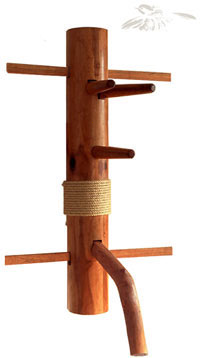

A punch at close range does not wait for you to identify it, choose a response, and get ready. Your body has to recognize pressure, line, distance, and intent while moving with balance. The best drills for reaction speed teach that skill under progressively more realistic conditions. They do more than make your hands move fast. They teach you to respond correctly when timing, contact, and position are changing.
For self-defense and martial arts, reaction speed is not simply a test of reflexes. A person can slap at a visual cue quickly and still be late against a committed attack. Useful reactions depend on posture, awareness, relaxed movement, and a trained response that does not require a long decision process.
What Reaction Speed Means in Fighting
A reaction starts with a stimulus. That stimulus may be visual, such as a shoulder moving before a punch. It may be tactile, such as feeling an opponent’s arm press, pull, or change direction. Then comes recognition, decision, and physical movement. If any part of that chain is slow, the response arrives late.
This is why random flashing-light exercises have limited carryover to close-range fighting. They can be enjoyable and may improve general alertness, but they do not teach structure, centerline control, or the ability to maintain your base while someone is in contact with you. Training should connect speed to a purpose: intercepting an attack, creating an angle, clearing a line, or regaining control of the opponent’s balance.
The goal is not to react to every motion. The goal is to read meaningful motion and answer it with the simplest effective action.
7 Best Drills for Reaction Speed
1. Visual Cue Interception Drill
Start with a partner standing at a safe range. The feeder gives one of two or three clear attacks, such as a straight punch, a low-line touch, or a step forward. Your job is to respond immediately with one appropriate defensive action and a controlled counterline, rather than trying to invent a new answer every time.
Keep the attack speed low enough that you can maintain correct body position. If you lean backward, reach with your arms, or close your eyes, the drill has become too fast for productive learning. Increase speed only when you can keep your elbows connected, shoulders relaxed, and feet under you.
This drill develops visual recognition and decisive action. Its limitation is that visual cues can be deceptive. A skilled partner can fake with the eyes, shoulders, or hands, which is why visual drills should eventually be combined with contact training.
2. Tennis Ball Drop and Catch
The tennis ball drop is simple, but it can be valuable when used correctly. Have a partner hold a ball at shoulder height and release it without warning. Catch it before it hits the ground, switching hands and positions as you improve.
Do not confuse this with fighting practice. It is a basic nervous-system warm-up that trains attention and immediate movement, not a complete combat reaction drill. Use it for a few minutes at the beginning of training, then move to drills that require footwork, guarding position, and decision-making.
A useful variation is to begin in a natural stance and require a small step before the catch. This prevents the drill from becoming only a hand exercise and introduces coordination between the lower and upper body.
3. Partner Hand Tag From Guard
Face a partner at close range with both people in a relaxed guard. One person attempts to touch the other person’s shoulder, chest, or forearm with an open hand. The defender uses small movements – a deflection, angle change, hand control, or step – to prevent the touch while keeping their own center protected.
The feeder should not launch wild, high-speed slaps. Clean, controlled attacks give both partners a chance to learn timing. As skill improves, add choices: the feeder can attack with either hand, change levels, or use a light forward step.
This drill exposes a common problem. Many students react with their hands but leave their feet still. At close range, a small angle or half-step can make the defense work with far less effort. Train the hands and feet as one response.
4. Call-and-Response Footwork Drill
Reaction speed is often lost before contact because the feet are late. In this drill, a partner gives a verbal cue, hand signal, or directional step. Respond with a specific movement: step back, shift off line, advance on an angle, or pivot to regain the center.
Begin with fixed commands so the movements become clear. Later, let the partner choose the direction without calling it out. Your task is to keep your stance stable, avoid crossing your feet, and finish in a position where you can strike, control, or leave safely.
This is especially useful for beginners because it lowers the pressure of being hit while teaching a critical truth: range changes faster than most people expect. Efficient footwork buys time. It also creates better angles for a defensive action instead of forcing you to absorb everything head-on.
5. Pak Da Timing Drill
Pak da – a clearing hand combined with a direct strike – is a useful Wing Chun exercise for building simultaneous action. One partner feeds a controlled straight attack. The defender redirects the attacking arm while delivering a straight strike to a safe target, such as a focus mitt or chest protector.
The important detail is timing. Do not perform the clear first, pause, and then punch. The hand control and strike should arrive together, with the body moving forward in a balanced way. This reduces the number of separate actions required under pressure.
At first, the feeder should give a predictable line. Once the mechanics are sound, vary the timing and side. If the drill becomes a choreographed pattern, it will build coordination but not true response ability. Controlled unpredictability is what turns a technique into a reaction.
6. Chi Sao Sensitivity Rounds
Visual reaction has limits when an opponent is already close enough to touch you. Chi sao, or sticking-hands training, develops tactile sensitivity through continuous forearm contact. Instead of waiting to see every attack, you learn to feel pressure, openings, changes in direction, and weakness in the opponent’s structure.
Start with light pressure and a cooperative rhythm. Focus on keeping your elbows controlled, your shoulders loose, and your stance connected to the ground. When your partner presses into one line, do not fight force with force. Redirect, change angle, or use the opening created by their pressure.
As students become more comfortable, the round can include controlled strikes, traps, position changes, and stepping. The trade-off is that chi sao is highly specialized. It is excellent for close-range awareness, but it should not replace training at longer range or against non-Wing Chun attacks. Its value comes from teaching you to adapt when contact is already present.
7. Randomized Defense and Exit Drill
This drill brings recognition, response, movement, and judgment together. A partner stands at a realistic distance and can choose among several actions: a straight attack, a grabbing attempt, a forward rush, or no attack at all. The defender must respond appropriately, then create distance or move to a safer angle.
The option to do nothing matters. If you react aggressively to every twitch, you are training panic rather than control. A good defender stays alert without becoming committed too early. The correct response may be a hand control and counter, a step away, a frame to create space, or simply maintaining position.
Use protective equipment and clear intensity rules. This is not a contest to prove toughness. It is an opportunity to test whether your technique remains functional when you do not know what is coming next.
How to Make These Drills Produce Faster Results
Train reaction drills two or three times per week, but keep the rounds short enough to preserve attention. Fatigue can be useful for conditioning, yet it often makes people practice sloppy reactions. Five focused rounds of one to two minutes can teach more than twenty distracted minutes of frantic movement.
Use a progression. Start with one known attack and one known answer. Add a second option, then variable timing, then footwork, then light resistance. If a student cannot maintain structure at one level, adding more speed usually reinforces bad habits. Technical precision comes first because efficient mechanics are faster than muscular tension.
Also measure improvement by quality, not only by catches or successful blocks. Ask whether you kept your balance, protected your center, recognized the line early, and recovered position after the response. A fast movement that leaves you square, overextended, or off balance is not a reliable defensive reaction.
Reaction speed improves when training gives the body clear problems and repeatable solutions. If you want to develop those skills through close-range striking, arm control, footwork, and sensitivity work, South Florida Wing Chun Kung Fu Academy welcomes beginners and experienced martial artists to try a free class in Doral.