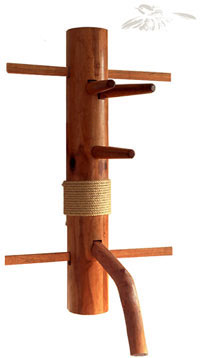

A beginner does not need to be fast, flexible, or naturally aggressive to begin martial arts. They need a training method that gives them usable positions, clear feedback, and a way to improve without being overwhelmed. So, is Wing Chun good for beginners? For many adults and older teens, yes. Its emphasis on structure, direct movement, balance, and close-range control can make it an excellent first martial art when it is taught with progressive, hands-on instruction.
Wing Chun is not a shortcut to fighting ability, and it is not learned by memorizing a few hand techniques. It is a technical system that develops how you stand, step, make contact, control an opponent’s arms, and apply force efficiently. That depth is exactly why beginners can benefit from it. You start with simple mechanics and keep refining them as your awareness and coordination grow.
Why Wing Chun Works Well for New Students
A good beginner program gives students a foundation before asking for speed or intensity. Wing Chun begins with body alignment, stance, guard position, and straightforward strikes. Rather than relying on high kicks, acrobatic movement, or athletic strength, the system teaches students to organize their body behind a technique.
This matters for someone who has never trained before. A punch has more stopping power when the feet, hips, spine, and hand work together. A defensive movement is more reliable when it does not pull the body out of balance. Wing Chun training repeatedly brings beginners back to these fundamentals until they become more natural under pressure.
The system also favors efficiency. At close range, there may not be room for large swinging motions. Wing Chun teaches direct lines, compact strikes, and arm control that can help a smaller person create space or disrupt an opponent’s attack. That does not mean size and strength stop mattering. They do. But good positioning and timing give a beginner better options than panic and uncontrolled movement.
Footwork Lowers the Barrier to Entry
Some people see Wing Chun’s close-range hand techniques and assume training happens with the feet planted. In practical instruction, footwork is essential. Students learn to step forward, retreat, turn, angle off, and maintain a stable base while striking or controlling contact.
For beginners, this is a major advantage. Footwork teaches distance before complicated combinations. It helps you understand when you are too close, when you are exposed, and how to avoid being directly in front of an incoming force. It also makes the art more accessible to people who may not be comfortable with high-impact jumping or kicking from day one.
A beginner should expect to spend time learning how to move without crossing their feet, leaning too far, or losing their structure. Those details may feel basic, but they are the difference between a technique that looks correct in the air and one that remains available when another person is pushing, grabbing, or resisting.
Is Wing Chun Good for Beginners Who Want Self-Defense?
Wing Chun can be a strong choice for beginners interested in self-defense because it addresses a range that many confrontations quickly enter: close contact. When someone grabs, crowds, shoves, or throws wide punches, the problem is not only how to strike. It is how to regain position while managing the opponent’s arms and your own balance.
Training may include straight punching, palm strikes, low-line kicks, defensive shapes, turning, and control of the opponent’s centerline. More advanced practice develops simultaneous hand-and-foot coordination, so a student can move, cover, strike, or off-balance an opponent without treating each action as separate.
One of Wing Chun’s distinctive training methods is tactile sensitivity practice. When forearms are in contact, students learn to feel changes in pressure, direction, and openings. This is not magic and it is not a replacement for awareness. It is a trained response to physical information. Over time, it can help a student react less blindly when vision is limited or the exchange becomes crowded.
Still, realistic self-defense requires judgment. Good training should include awareness, verbal de-escalation, escape routes, distance management, and an honest understanding of risk. No martial art guarantees safety against a larger attacker, a weapon, multiple people, or a surprise assault. The practical goal is to improve your ability to protect yourself, create an opportunity to leave, and stay composed enough to make better decisions.
What Beginners May Find Challenging
Wing Chun is beginner-friendly, but it is not effortless. Its movements can look simple from the outside, which sometimes leads new students to rush them. In reality, a clean straight punch, a stable turn, or a properly aligned arm control requires attention to the whole body.
You may also find that sensitivity drills feel unfamiliar at first. People new to partner training often tense their shoulders, chase hands, use too much force, or freeze when contact changes. That is normal. The purpose of practice is not to get every exchange right immediately. It is to build calm, adaptable reactions through repetition.
The close-range nature of Wing Chun can also feel more personal than a fitness class. You will train with partners at controlled distances, learning how pressure affects posture and movement. A professional school introduces that contact gradually, emphasizes respect and safety, and pairs students in ways that allow them to learn without intimidation.
Progress depends heavily on the quality of instruction. Beginners need explanations that connect technique to purpose: where the feet should be, what the hands are protecting, how force travels through the body, and why an angle is safer than standing squarely in front of someone. Random drilling without this context can make Wing Chun seem confusing. Structured instruction makes the system logical.
What a First Wing Chun Class Should Feel Like
Your first class should challenge you without trying to prove how tough you are. Expect a warm-up, basic stance and footwork, simple striking mechanics, and partner exercises that introduce distance and contact. You may practice on pads, work through controlled hand positions, or learn a small section of a form.
The instructor should correct details, but the room should remain welcoming. You do not need prior martial arts experience, expensive equipment, or the ability to perform advanced movements. Wear comfortable training clothes, arrive ready to pay attention, and ask questions when a position does not make sense.
A useful first-class question is not, “Did I win?” It is, “Did I understand something new about balance, range, or how my body moves?” Martial arts progress is built from those small realizations. The student who trains consistently will develop far more than the student who only looks for dramatic techniques.
Choosing the Right School Matters
If you are considering Wing Chun in Doral, Miami, or elsewhere in South Florida, observe how a school treats beginner development. Look for instruction that includes footwork, striking, controlled partner work, and explanations of structure rather than only choreographed sequences. Students should be learning to adapt to pressure, not merely performing techniques for appearance.
It is also worth asking how sparring or resistance is introduced. Beginners do not need to be thrown into hard contact immediately, but they do need a path toward realistic application. Progressive resistance teaches you whether your posture holds up, whether your timing works, and how to stay composed when a partner is actively moving.
At South Florida Wing Chun Kung Fu Academy, students can begin with the fundamentals and build toward the deeper mechanics of close-range fighting. The focus is not on collecting moves. It is on developing body structure, responsive footwork, arm control, and decisive force application through disciplined practice.
The Best Beginner Is the One Who Keeps Training
Wing Chun is especially suitable for people who enjoy learning details and want a martial art that becomes deeper over time. You can begin with a basic stance and a straight punch, then spend years improving how you generate force, occupy space, control contact, and create angles under pressure.
It may be less appealing if you only want a casual workout with no interest in technical practice. Wing Chun asks for concentration. It rewards patience. For the right beginner, that is not a drawback. It is the reason training becomes meaningful.
The most useful next step is simple: try a class, feel the training for yourself, and see whether the instruction gives you confidence rather than confusion. Come join us today and try out a free class.