
Ask ten people for the most effective fighting technique, and you will usually get ten different answers – boxing, wrestling, Muay Thai, Brazilian Jiu-Jitsu, Krav Maga, or some version of “whatever works.” That answer sounds practical, but it misses the real issue. A technique is only effective when it fits the distance, timing, pressure, and body mechanics of the moment. In actual self-defense, the question is not which move looks strongest. It is which method lets you control the exchange when someone is resisting, crashing forward, grabbing, or striking at close range.
Why the most effective fighting technique is not one move
People often search for a single answer because it feels efficient. If there is one best punch, one best takedown, or one best submission, then training seems simpler. Real fighting does not work that way. A straight punch can be highly effective, but only if you have the line, balance, and timing to land it cleanly. A takedown can end a confrontation fast, but only if you enter safely and manage the opponent’s base. Even a strong clinch position is only useful if you understand posture, angle, and pressure.
The most effective fighting technique is better understood as a set of connected skills rather than an isolated motion. You need the ability to close distance without absorbing unnecessary damage, interrupt the opponent’s attack, control their structure, and deliver force while staying balanced yourself. That is why systems built around timing, contact awareness, and efficient mechanics often hold up well under pressure. They train the transition between moments, not just the moment you hope to catch.
What actually makes a fighting technique effective
An effective technique does four things well. First, it works at the range where the fight is happening. Second, it holds up against resistance. Third, it gives you a structural advantage instead of relying only on speed or strength. Fourth, it connects to what comes next.
This last point matters more than many beginners realize. A punch that lands but leaves you overextended can fail even when it makes contact. A trap that briefly clears the opponent’s arm but does not create a line for follow-up is incomplete. A throw that puts you on unstable footing can create as many problems as it solves. Good fighting methods are not judged only by first contact. They are judged by what they allow you to do immediately after.
That is where technical training separates itself from guesswork. The body has to learn how to produce force without sacrificing position, how to recover balance during forward pressure, and how to change from striking to arm control to angle creation in a continuous way.
The range problem most people ignore
A lot of debate around the most effective fighting technique falls apart because people do not define range. Long-range striking, clinch fighting, and ground fighting all have different demands. A method that works beautifully from open space may become difficult once someone crashes into you and smothers your movement.
For self-defense, this is especially important. Many real altercations do not begin from a clean stance at ideal distance. They start with verbal pressure, crowding, a shove, a grab, or sudden forward aggression. That means close-range mechanics deserve serious attention. You need tools that function when there is no room for wide motion and no time to reset.
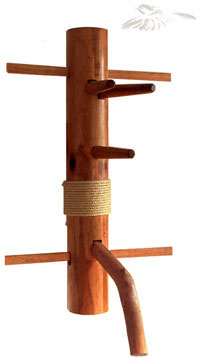
Wing Chun has long focused on this problem. Its value is not in fantasy claims of being unbeatable. Its value is in how it organizes close-range fighting around centerline awareness, hand-and-foot coordination, forward structure, and tactile response under contact. Those are useful attributes when a fight compresses quickly and space disappears.
Why structure beats raw effort
Under stress, people tend to swing harder, rush forward, and tense up. That feels aggressive, but it often reduces accuracy, balance, and recovery. Effective fighting is not just about trying harder. It is about placing the body so force travels efficiently into the target while your own position stays functional.
Structure is what allows a smaller person to create meaningful pressure without wasting movement. Proper alignment in the legs, hips, torso, and arms lets you strike, redirect, and control with less telegraphing. It also improves your ability to absorb incoming force and keep moving.
This is one reason disciplined close-range systems remain relevant. If your mechanics teach you to occupy line, disturb the opponent’s balance, and hit while controlling their limbs, you are not depending on a single dramatic shot. You are building a chain of advantage.
Timing and pressure change everything
A technique that looks clean in demonstration may fail once the opponent resists, changes rhythm, or drives through contact. Timing is not a bonus skill. It is part of the technique itself. So is pressure.
If you cannot apply a movement while being rushed, jammed, or partially tied up, you do not yet know that movement in a fighting sense. This is why tactile training matters. Once contact is made, vision alone is often too slow to manage the exchange. The arms and body must learn to read pressure, adapt angle, and continue attacking or controlling without pausing to think through each step.
Is there a single most effective fighting technique for self-defense?
If the goal is self-defense rather than sport, the answer becomes narrower. You need methods that are simple enough to apply under stress, versatile enough to handle messy entries, and efficient enough to work in close quarters. That shifts the focus away from flashy combinations and toward interception, positional control, direct striking, and mobility.
In that context, the most effective fighting technique is often not a finish at all. It may be the ability to intercept an incoming attack, control the opponent’s arms, break their balance, and strike while moving to a better angle. That sequence is less glamorous than a knockout punch or submission highlight, but it is often more realistic.
This is where principle-driven training has an edge. Instead of memorizing many unrelated moves, you learn how to manage line, pressure, and base. From there, different actions become available naturally. A strike opens because the line is clear. A turn works because the opponent’s balance is compromised. A step creates safety because your angle changed before the next attack arrived.
Why Wing Chun belongs in this conversation
Wing Chun should be part of any serious discussion about the most effective fighting technique because it addresses a specific part of fighting that many people underestimate: what happens after contact is made and the exchange becomes tight, fast, and chaotic.
Its training methods develop simultaneous offense and defense rather than treating them as separate phases. They teach control of the center, quick force delivery from short distance, and coordinated stepping that supports both attack and recovery. The goal is not to trade power recklessly. The goal is to create a positional advantage where your strikes and controls work together.
That does not mean Wing Chun is a magic answer or that every practitioner automatically fights well. Like any martial art, it depends on training quality, realism, and consistency. But when taught with pressure, structure, and practical intent, it offers a clear framework for close-range self-defense that many adults find both technical and accessible.
Trade-offs matter
Every method has trade-offs. Boxing develops sharp hands, head movement, and timing, but it does not specialize in limb control the way some close-range systems do. Wrestling builds pressure, takedowns, and positional dominance, but going to the ground in a self-defense situation can carry obvious risks. Brazilian Jiu-Jitsu offers strong ground control, but the entry to the ground and the environment itself may not always favor it.
Wing Chun’s trade-off is that it asks for disciplined technical development. You do not get its benefits from casual practice or choreography. You have to train contact, footwork, reaction, and structure with intent. For students willing to do that, the payoff is a functional understanding of how to fight when distance collapses.
How to think about effectiveness when choosing training
If you are evaluating martial arts for practical use, stop asking which style wins an internet argument. Ask better questions. Does this training address the range where many real confrontations occur? Does it teach you how to stay balanced while applying force? Does it include resistance, pressure, and adaptation? Does it show you how one action connects to the next?
For many adults and older teens, the best answer is not the broadest program. It is the one that teaches a coherent system with clear mechanics and realistic training methods. A specialized approach can be more useful than a little bit of everything, especially if your goal is real skill rather than entertainment.
If you are in South Florida and want to explore how close-range structure, timing, and contact-based reactions actually work, South Florida Wing Chun Kung Fu Academy offers a direct way to experience that training. Try out a free class, ask questions, and feel the mechanics for yourself.
The most effective fighting technique is the one you can apply with balance, timing, and control when pressure is real – and that kind of effectiveness is built through disciplined training, not guesswork.