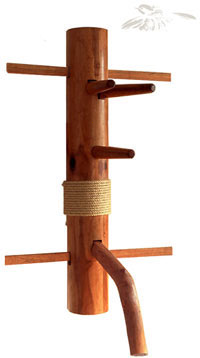

The first time someone tries chi sao, they usually expect a fast hand drill. What they feel instead is pressure, balance changes, missed openings, and the strange realization that contact can tell you more than sight. If you have been wondering how does chi sao training work, the short answer is this: it teaches you to read force through touch and respond with structure, timing, and efficient movement at close range.
In Wing Chun, chi sao is not random hand fighting and it is not a performance drill. It is a training method that develops tactile sensitivity under forward pressure. When two training partners maintain arm contact, they create a feedback loop. That loop teaches you how to recognize an opening, recover your line, control incoming force, and strike without loading up or chasing motion.
How Does Chi Sao Training Work in Wing Chun?
Chi sao means sticking hands, but the phrase can be misunderstood if you picture two people trying to glue their arms together. The point is not to stay attached at all costs. The point is to use contact to gather information. Once your arms meet your partner’s arms, you can feel direction, tension, collapse, expansion, and changes in intent faster than you can process them visually.
That matters because close-range fighting happens quickly. At that distance, large reactions are too slow and exaggerated movements create openings. Chi sao trains the body to make smaller, more accurate decisions. Instead of guessing, you learn to feel whether the path is open, obstructed, or dangerous.
A good chi sao session builds skill in layers. Beginners first learn the shapes and positions so they are not flailing. Then they learn how to maintain structure while moving under pressure. After that, they begin to recognize when force should be redirected, when the centerline is available, and when stepping is necessary to improve angle and base. Over time, the drill becomes less about memorizing movements and more about developing usable reflexes.
The Core Mechanics Behind Chi Sao
The most important part of chi sao is not speed. It is structure. If your elbow position, stance, and body alignment are poor, the drill turns into a contest of slapping hands and muscular resistance. That misses the point entirely.
In Wing Chun, structure allows force to travel through the body efficiently. When your frame is organized, you do not need to tense every muscle to hold position. You can stay responsive instead of rigid. That is why experienced practitioners often feel unexpectedly heavy, stable, or difficult to move even when they are not using obvious strength.
Forward intent is another key concept. This does not mean leaning or charging. It means maintaining active pressure toward the center so your hands are alive, connected, and ready to occupy space. Without forward intent, chi sao becomes passive. With too much force, it becomes a wrestling match. The right amount creates sensitivity.
Relaxation also matters, but it has to be understood correctly. Relaxed does not mean limp. It means free of unnecessary tension. If your shoulders are tight and your forearms are stiff, you will feel less and react later. If you stay organized and calm, your hands can adapt more quickly.
What Actually Happens During Practice
Most chi sao training begins with simple rolling patterns. These patterns are not the final skill. They are a platform for learning angle, pressure, hand replacement, and elbow control. The repetition gives both partners a shared framework so they can develop awareness without chaos.
As students improve, the drill becomes less cooperative. Openings appear. Traps, strikes, redirections, and positional changes start to emerge. A partner may increase pressure, change rhythm, collapse a line, or attempt to take control of your base through arm contact and footwork. Your job is not to win the exchange through force. Your job is to keep your structure, recognize the change, and answer efficiently.
This is where chi sao becomes valuable. The contact gives immediate feedback. If your elbow drifts, you lose the line. If your stance is weak, your balance gets affected. If you overcommit with the hands, your center opens. You do not need a lecture to understand the mistake because you can feel it in real time.
That said, chi sao should not be mistaken for sparring. It is a bridge between isolated drills and live application. It sharpens specific attributes that matter in close-range fighting, especially reaction through touch, hand replacement, control of pressure, and the ability to strike while managing incoming force. But if someone only does chi sao and never trains entries, footwork, timing against non-compliant attacks, or general fighting skills, the results will be incomplete.
Why Chi Sao Builds Real Skill
The value of chi sao is that it compresses a lot of combat information into a controlled format. At close range, visual reactions are often too late. Hands collide, positions shift, and balance changes in fractions of a second. Chi sao trains your nervous system to process those transitions through touch.
This leads to several useful attributes. One is economy of motion. Because the drill punishes wide, unnecessary movement, students begin to favor shorter actions. Another is recovery. Even when a position breaks down, trained practitioners can regain line and posture quickly instead of freezing. A third is force adaptation. When pressure increases, they learn when to yield, when to redirect, and when to drive forward.
There is also a strategic benefit. Chi sao teaches you not to chase hands. If your partner moves away from the line, the instinct should not be to follow every motion. The instinct should be to take the path that becomes available. That is a major difference between technical training and frantic hand trading.
Common Misunderstandings About Chi Sao
One common mistake is thinking chi sao is only for advanced students. In reality, beginners can benefit from it early if the instruction is structured properly. They do not need to perform at a high level on day one. They need to begin learning what pressure, alignment, and contact feel like.
Another misunderstanding is that chi sao is unrealistic because real fights do not start from rolling hands. That criticism is partly fair and partly shallow. It is true that actual conflict does not begin in a neat drill. But that is not the purpose of the exercise. Chi sao isolates a critical range and teaches what to do once contact is established. The mistake is not chi sao itself. The mistake is treating it as the whole art.
Some people also turn chi sao into a speed game. Fast hands can look impressive, but speed without control usually hides weak structure and poor decision-making. Clean timing, angle, and balance matter more than flurries.
How Good Instruction Changes the Drill
Chi sao only works when it is taught with purpose. A good instructor does more than show rolling patterns. They correct elbow position, shoulder tension, stance integrity, stepping, line control, and the relationship between upper-body action and lower-body support. They also know when to keep the drill simple and when to increase unpredictability.
This is especially important for adults who want practical skill, not just choreography. Good training connects chi sao to striking, entry work, defensive reactions, and footwork under pressure. It shows how hand contact affects the opponent’s base and how angle changes create safer attacking paths.
At a serious school, chi sao is part of a larger system. It supports punching, trapping, turning, stepping, and close-range control. It helps students understand why Wing Chun emphasizes coordination between the hands and feet instead of treating the arms as separate from the body.
Is Chi Sao Useful for Self-Defense?
It can be, if your expectations are realistic. Chi sao is very useful for developing the ability to function when space collapses and arms make contact. That happens often in real altercations, especially at conversational distance or during aggressive forward pressure. The skill to feel and respond instead of panicking has real value.
But self-defense is broader than one drill. Awareness, distance management, verbal skills, timing, and scenario training all matter too. Chi sao improves a specific part of the problem: what happens when hands are already touching and decisions must be made immediately.
For many students, that makes it one of the most interesting parts of Wing Chun. It is technical enough to study for years, but practical enough to feel the difference quickly. You begin to notice less wasted motion, better balance, and more confidence under pressure.
If you want to understand chi sao, the best approach is not to watch endless clips and guess what is happening. Put your hands on a skilled practitioner and feel the mechanics directly. If you are in Doral or the greater South Florida area and want to experience how Wing Chun is taught in person, try out a free class and ask questions. A good session will make the answer clear long before words do.