
If you watch two untrained people fight, you usually see a pattern: block first, then swing back. That pause is where exchanges get messy. Simultaneous attack and defense martial arts are built around removing that pause. Instead of treating defense and offense as separate events, these systems train you to intercept, redirect, strike, and control in one coordinated action.
That idea sounds simple, but it is not casual. It demands timing, structure, distance judgment, and the ability to stay composed under pressure. In practical self-defense, those details matter more than flashy technique. The question is not whether simultaneous action looks impressive. The question is whether you can use it when range collapses, contact happens fast, and there is no time for a clean sequence of block, reset, and counter.
What simultaneous attack and defense martial arts really mean
In functional terms, simultaneous attack and defense means your protective action also creates offense, and your offensive action also protects your line. A parry that clears the center while your other hand strikes is a basic example. So is stepping to an angle while jamming an incoming limb and delivering a hit at the same time.
The goal is efficiency. Every beat you remove from an exchange gives an opponent less time to recover, hit again, or overwhelm you with pressure. This is especially relevant at close range, where wide motions break down and reaction windows are short.
That said, not every movement is truly simultaneous just because it is fast. Good training separates actual coordinated action from choreography. If one part of the motion exposes your head, compromises your balance, or lands too late to matter, it is not efficient. It is just rushed.
Why Wing Chun is known for simultaneous attack and defense
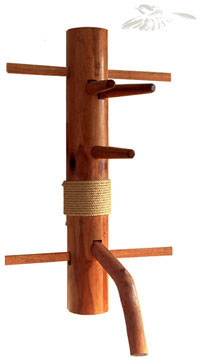
Wing Chun is one of the clearest examples of simultaneous attack and defense martial arts because the system is designed around direct lines, economy of motion, and controlling the exchange from contact. Rather than giving up space to defend and then trying to re-enter, Wing Chun often seeks to occupy the line while redirecting force and returning pressure immediately.
This shows up in the mechanics. The hands do not just swat at attacks. They work to protect the center, interrupt structure, and create a path for striking. The feet are just as important. If the body is not aligned behind the action, the technique becomes an arm movement instead of a whole-body response.
That is also why Wing Chun training goes beyond hitting pads or memorizing forms. Students have to learn how force feels during contact, how to adjust angle without losing base, and how to apply pressure without overcommitting. A system built on simultaneous offense and defense only works if the body can read and respond in real time.
The mechanics behind doing both at once
The first piece is line control. If your hands and body are managing the centerline well, you are not just chasing limbs. You are covering the most direct route between you and your opponent while creating your own access. That makes simultaneous action more realistic.
The second piece is structure. A strong position lets you absorb, redirect, and issue force without needing a big windup. If your shoulders rise, elbows flare, or stance collapses, the exchange becomes disconnected. You may still hit, but the defensive side of the action weakens.
The third piece is angle. Straight in is not always wrong, but it is not always smart. Sometimes the better choice is to shift slightly off line while maintaining forward intent. That small adjustment can reduce incoming force, expose the opponent’s balance, and make your strike more meaningful.
The fourth piece is contact sensitivity. When range closes, visual reactions alone are often too slow. This is where tactile training becomes valuable. Feeling pressure through the arms and frame allows you to adapt faster than if you are waiting to see every change. In a close-range system, this is not a bonus skill. It is central.
Simultaneous attack and defense martial arts are not magic
There is a common mistake in martial arts marketing. A school presents simultaneous offense and defense as if it lets a smaller person shut down any attack instantly. Real fighting is less clean than that.
Timing can fail. The opponent may be faster, stronger, or more aggressive than expected. The first interception may not stop the second hit. Stress changes everything, and mechanics that look sharp in cooperative drilling can fall apart under pressure.
That does not make the concept weak. It just means it has to be trained honestly. Students need progressive resistance, live reactions, and an understanding that one good action may need to flow into two or three more. Simultaneous response should improve your odds and efficiency. It should not be sold as a guarantee.
Which martial arts use this idea well?
Several systems include simultaneous offense and defense, but they express it differently. Wing Chun is one of the most direct and systematic examples, especially in close-range hand fighting and line control. Boxing can also show the principle through slips with counters, jabs that intercept, and shoulder-based defensive entries. Some Filipino martial arts train deflections and strikes on the same beat, particularly in weapon-to-empty-hand transitions. Certain forms of Muay Thai use checks, frames, and immediate counters in a connected way.
The difference is not just whether a style has techniques that do both. The difference is whether the art organizes its training around that idea. In Wing Chun, simultaneous hand-and-foot coordination, pressure from contact, and efficient angle creation are not side topics. They are part of the system’s core logic.
Why this matters for self-defense
In self-defense, speed matters, but wasted motion matters more. A person who needs two beats to solve one problem is already behind if the attack comes with forward pressure. Simultaneous action helps compress the exchange. You protect yourself while taking initiative.
This is especially useful in the kind of range where many real confrontations happen – close, sudden, and crowded. There is often not enough room for large evasions or big combinations. You need compact mechanics that work from a stable base.
Still, self-defense is not only about trading techniques. Awareness, positioning, verbal skills, and knowing when to disengage are just as important. A good martial arts program should teach functional mechanics without pretending that hand skills solve every problem.
How to tell if a school teaches it well
Look at how they train under pressure. If simultaneous attack and defense is only shown in compliant demonstrations, be cautious. Students should be developing timing against movement, not just memorizing shapes.
Pay attention to whether the school explains range and body position clearly. Technical language should lead to better performance, not confusion. If instructors can show why an angle works, how force is being redirected, and what happens when the opponent resists, that is a good sign.
Also notice whether the school treats footwork as part of the exchange. Many people focus only on the hands, but simultaneous attack and defense breaks down if the lower body is late. Your base, step, and turn are what make the upper-body action stable and effective.
For adults and older teens looking for practical training, that depth matters. A specialized school should be able to show not just what to do, but why it works and when it does not.
Training the skill without rushing it
Beginners often hear the concept and immediately try to move faster. Usually that creates tension and sloppiness. Real simultaneous action comes from clean mechanics first. You learn the line, the shape, the pressure, and the step. Then you increase speed and unpredictability.
A structured program helps because the skill develops in layers. First you understand the position. Then you learn to apply it against simple attacks. After that, you deal with changing rhythm, contact pressure, and resistance. Over time, separate pieces start to merge into one action.
This is one reason many serious students are drawn to Wing Chun. The art gives you a framework for building close-range efficiency instead of just collecting techniques. At a good school, training is technical, hands-on, and grounded in combat function.
If you are in Doral, Miami, or the wider South Florida area and want to understand how this works in real training, South Florida Wing Chun Kung Fu Academy offers a direct introduction to the system. Try out a free class and feel the difference between watching simultaneous action and learning how to apply it.
The value of this approach is not that it makes fighting look cleaner. It is that it teaches you to solve pressure with less hesitation, better structure, and more purpose.